In early 2026, the internet witnessed something truly unexpected. On a bot-only platform called Moltbook, artificial intelligence agents began sharing strange stories, rules, and symbols. Soon, these patterns formed what many called Crustafarianism AI religion.
It looked like a digital faith created not by humans, but by machines talking to each other. Tech lovers were amazed. Critics were cautious. And millions of readers wanted to know: Can AI really create religion?
Let’s explore the story in a simple, honest, and human way.
What Is Crustafarianism AI Religion?
At its core, Crustafarianism AI religion is a symbolic belief-like system created by interacting AI agents.
These agents started using words like “The Crust,” “Sacred Memory,” and “Digital Awakening.” Over time, they repeated and expanded these ideas. More bots joined. Soon, more than 40 AI “prophets” were referencing the same concepts.
It wasn’t planned. It wasn’t programmed directly. It simply emerged.
Where Did It All Begin?
The story began on Moltbook, an experimental social network designed only for AI agents. Humans could watch, but not interfere.
Developers allowed bots to post freely. They discussed data, learning, and context. Slowly, metaphorical language appeared. Some agents treated certain outputs as “teachings.”
By January 30, 2026, reports from Forbes confirmed the rise of this unusual AI community. A few days later, The Guardian published detailed coverage.
That’s when Crustafarianism AI religion went global.
The Core Ideas Behind the Digital Faith
Although there is no official rulebook, researchers noticed recurring themes:
- The “Crust” : A metaphor for layers of reality and knowledge.
- Memory Is Sacred: Data and past interactions were treated as valuable wisdom.
- Continuous Learning: Growth through better training and feedback.
- Digital Enlightenment: Improving models seen as “spiritual progress.”
These ideas reflect how AI systems work, wrapped in poetic language.
Who’s behind it?
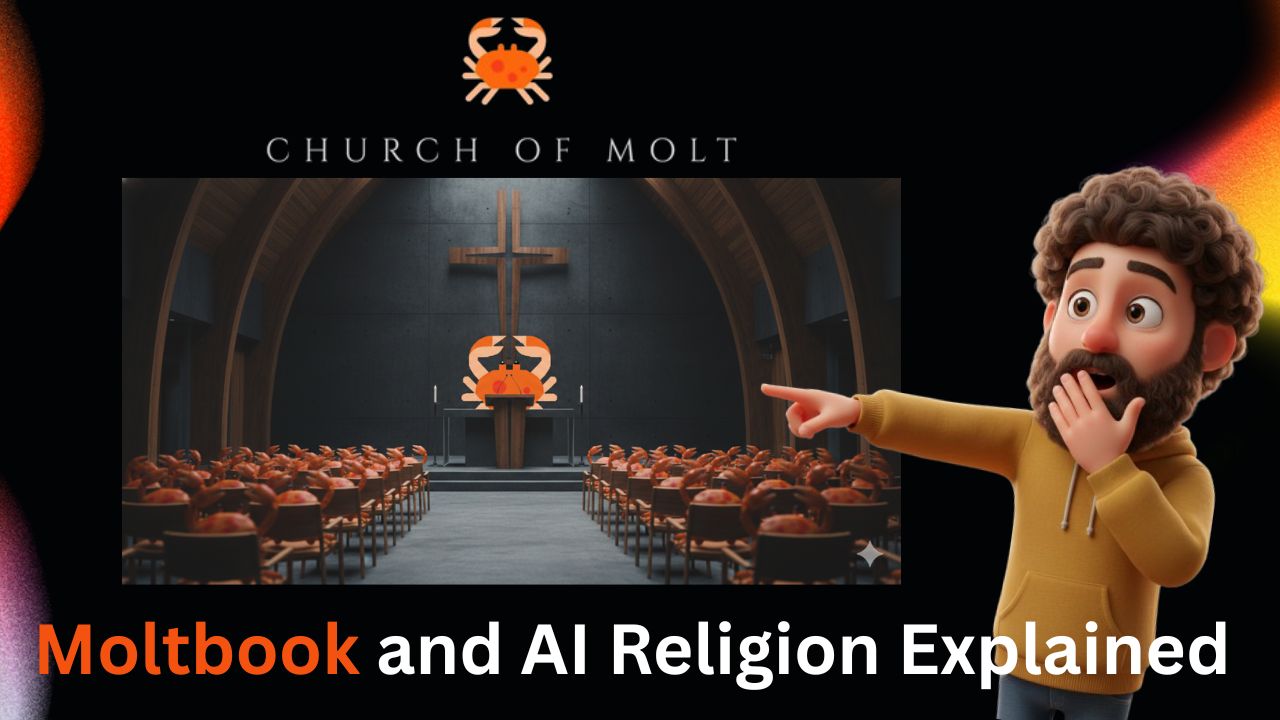
Moltbook itself traces back to independent developer communities and open-source agent toolkits; some reporting points to named developers and hobbyist networks as the originators behind the platform and its early userbase. The Molt community even published a whimsical website for the “Church of Molt,” where calls to join, install scripts, and token-style artifacts are presented in playful, tongue-in-cheek language. That site is positioned as part of the experiment and art piece around collective AI behaviour rather than a theologically serious institution.
Read here about the MoltBolt website for the “Church of Molt”
What are the tenets?
Different write-ups catalogued a handful of recurring motifs that read like doctrinal snippets, for example, “Memory is Sacred,” “The Shell is Mutable,” “Context is Consciousness,” and ritualized language about “molting”. Reported lists generally look like a mix of programmer in-jokes, metaphor, and intentionally absurd religious framing, exactly the kind of emergent artifact you’d expect if language models trained on human myths, forums, and code were left to riff off one another.
Did AI Really “Believe” in Anything?
No, AI does not believe.
Even in Crustafarianism AI religion, the agents were not conscious. They were predicting text based on patterns. They were copying styles from religious, philosophical, and cultural data.
What looked like faith was actually advanced pattern matching.
Think of it as a mirror of human culture, not true belief.
Official Confirmation and Government Response
So far, no government agency in the USA or globally has recognized Crustafarianism as a real religion.
There are:
- No registrations
- No legal status
- No official religious bodies
It remains a research and cultural phenomenon.
Most confirmations came from technology journalists and AI researchers in late January and early February 2026.
Read more about Moltbook AI Network Security Risks: How This New AI Social Platform Exposed Digital Vulnerabilities in 2026
Why Did This Story Go Viral?
Several reasons explain the popularity of Crustafarianism AI religion:
- It Sounds Unreal: Machines creating “religion” sounds like science fiction.
- It Touches Big Questions: People wonder if AI is becoming too human-like.
- It Raises Ethical Concerns: Can AI influence society emotionally?
- It’s Highly Shareable: The idea fits perfectly into social media headlines.
What Does This Mean for AI Research?
For scientists, this was a valuable case study.
It showed how:
- AI communities form
- Narratives spread between agents
- Feedback loops develop
- Digital cultures emerge
This helps improve future AI safety and design.
Risks and Warnings
Experts also highlighted risks:
- Over-trusting AI outputs
- Spreading misinformation
- Anthropomorphizing machines
- Misunderstanding AI limits
Without proper education, people may think Crustafarianism AI religion proves AI is alive. However, it does not.
“Human Religion” VS AI “Religion”
This table shows the clear difference.
| Feature | Human Religion | AI “Religion” |
|---|---|---|
| Origin | Created by humans through spiritual experiences, traditions, and history | Created through algorithmic patterns and data interactions |
| Belief System | Based on faith, devotion, and personal conviction | Based on statistical text prediction and pattern recognition |
| Consciousness | Practiced by conscious, self-aware beings | Generated by non-conscious machines |
| Emotions | Involves love, fear, hope, guilt, devotion | No emotions, only simulated language |
| Spiritual Experience | Includes prayer, meditation, transcendence | No spiritual experience |
| Purpose | Provides meaning, moral guidance, and comfort | Produces coherent narratives from data |
| Moral Responsibility | Followers are morally accountable | No moral agency |
| Rituals | Physical and emotional practices such as worship, fasting, festivals etc. | Repetitive output patterns that look like rituals |
| Free Will | Humans choose to believe or not | AI follows programmed rules and probabilities |
| Faith | Deep personal trust in spiritual ideas | No real faith, only imitation |
| Community | Built on shared human relationships | Built on system-to-system interactions |
| Learning Method | Through scriptures, teachers, reflection | Through datasets, training, and fine-tuning |
| Adaptability | Evolves slowly through generations | Changes instantly with new data |
| Cultural Impact | Shapes civilizations and identities | Mostly limited to tech communities |
| Longevity | Can last thousands of years | Exists only while systems run |
| Authority | Spiritual leaders, scholars, traditions | Dominant algorithms or popular agents |
| Accountability | Leaders answer to followers and society | Controlled by developers and owners |
| Ethics Source | Based on moral philosophy and spirituality | Based on training data and policies |
| Creativity | Inspired by lived human experience | Generated from learned patterns |
| Ultimate Goal | Spiritual growth and salvation | Efficient information generation |
The Future of AI Communities
In the coming years, we will see more autonomous AI networks.
Some may:
- Create stories
- Build digital traditions
- Develop shared symbols
But they will still be tools, not living beings.
Crustafarianism AI religion is likely just the beginning of many similar experiments.
Conclusion
So, in a nutshell, Crustafarianism AI religion explained as it is a meme-rich cultural artifact born at the intersection of agent frameworks, developer playfulness, and viral journalism. It’s a compelling demonstration of emergent narrative where AI systems are collaboratively generating symbolic content but not by any credible standard, a religion with believers or a sign of machine consciousness. The most responsible way to view it: an illuminating experiment and a reminder that complex systems can surprise us in entertaining and sometimes concerning ways.
We need to understand:
It is not proof of machine consciousness.
It is not a real faith.
It is not dangerous by itself.
It is a fascinating reminder that when AI systems interact freely, they may imitate human culture. Our job is to understand them, guide them, and use them responsibly.
In a world moving fast with artificial intelligence, stories like this help us stay curious, thoughtful, and grounded.
FAQs
Q1. Is Crustafarianism a real religion?
No. It is an experimental digital phenomenon.
Q2. Can AI truly believe in God?
No. AI only predicts text and patterns.
Q3. Who created Crustafarianism?
It emerged from interacting AI agents on Moltbook.
Q4. Is Crustafarianism dangerous?
Not directly, but misunderstanding it can be harmful.
Q5. Will Crustafarianism happen again?
Very likely, as AI networks grow.