Artificial intelligence is becoming the backbone of modern scientific research, energy innovation, and national competitiveness. Recognizing this shift, Oracle and the U.S. Department of Energy (DOE) have announced a major collaboration to accelerate AI initiatives across national laboratories and research programs.
This partnership is part of the DOE’s ambitious Genesis Mission, a nationwide effort to bring cutting-edge AI, cloud computing, and supercomputing power to government-led scientific research.
In this article, we break down what this collaboration means, why it matters, and how it could shape the future of AI-driven discovery in the United States.
What Is the Oracle DOE AI Collaboration?
The collaboration between Oracle and the U.S. Department of Energy is a public-private partnership designed to support the DOE’s growing demand for artificial intelligence and high-performance computing (HPC).
Under this initiative, Oracle will provide:
- Advanced cloud infrastructure
- AI-ready high-performance computing resources
- Technical expertise to support AI workloads
The goal is simple but powerful: give researchers faster, easier access to AI tools so scientific discovery doesn’t slow down while massive supercomputers are being built.
Date of Oracle DOE AI Collaboration :
The U.S. Department of Energy (DOE) announced the Oracle collaboration as a part of the Genesis Mission on December 18, 2025
Understanding the DOE Genesis Mission
The Genesis Mission is a strategic AI program launched by the U.S. Department of Energy to strengthen America’s leadership in science and technology.
Key objectives of the Genesis Mission include:
- Accelerating scientific discovery using AI
- Supporting energy innovation and climate research
- Strengthening national security and competitiveness
- Making AI infrastructure accessible to public researchers
More than two dozen technology companies are participating, including Oracle, NVIDIA, Microsoft, Google, and leading AI firms.
Sources
| Oracle’s official press release: Oracle and the U.S. Department of Energy Collaborate to Accelerate AI Initiatives (Dec 18, 2025) | Read Here |
| U.S. Department of Energy pages on the Genesis Mission and the new supercomputer partnerships (energy.gov) | Read Here |
Why Oracle’s Role Is Important
Oracle brings deep experience in enterprise cloud computing and AI infrastructure. For the DOE, this means:
1. Immediate AI Computing Access
Building large AI supercomputers takes time. Oracle’s cloud allows researchers to start AI projects immediately, without waiting for physical systems to be completed.
2. Scalable AI Infrastructure
Oracle’s cloud and HPC platforms are designed to scale up for large datasets, complex simulations, and advanced AI models.
3. Enterprise-Grade Security
Government research requires strict security and compliance. Oracle’s infrastructure meets high security standards required by federal agencies.
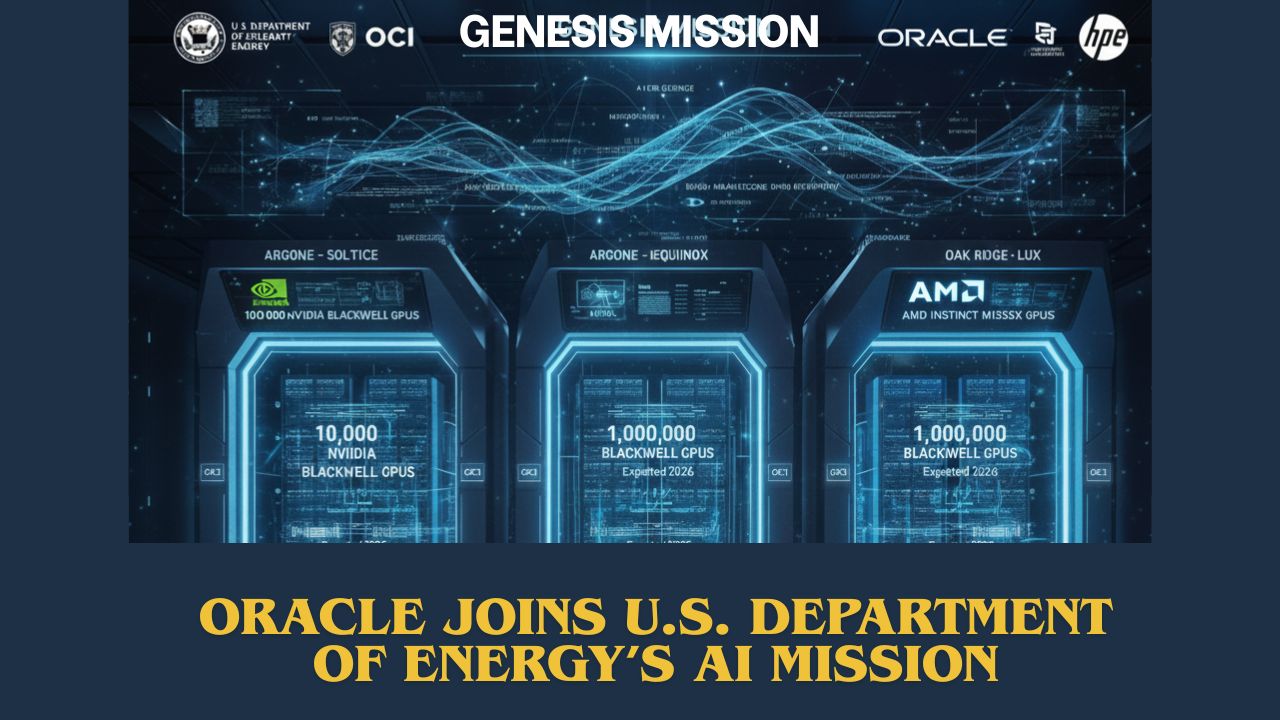
AI Supercomputers: Solstice and Equinox
A major highlight of the DOE’s AI strategy is the development of next-generation AI supercomputers:
- Solstice:
- Expected to feature around 100,000 NVIDIA Blackwell GPUs
- Designed for large-scale AI training and scientific simulations
- Equinox:
- Smaller but powerful system with approximately 10,000 GPUs
- Focused on early-stage AI research and testing
Oracle’s cloud resources will act as a bridge, ensuring researchers can work productively while these systems are under development.
Where Will This AI Power Be Used?
The AI capabilities enabled by this Oracle DOE AI collaboration will support research across many critical fields:
- Energy systems and grid optimization
- Climate modelling and weather prediction
- Materials science and battery research
- Nuclear energy and fusion research
- Quantum computing and advanced simulations
By combining AI with scientific research, the DOE aims to shorten the time between discovery and real-world impact.
Why This Partnership Matters for the U.S.
This Oracle DOE AI collaboration is about more than technology, it’s about the national strategy.
- It strengthens U.S. leadership in AI
- It ensures public researchers have access to world-class computing tools
- It reduces dependence on foreign AI infrastructure
- It encourages responsible AI development within government frameworks
Public-private partnerships like this allow innovation to move faster while keeping research aligned with public interest.
How This Oracle DOE AI Collaboration Influence India’s AI Research and Cloud Market
Even though the Oracle DOE AI Collaboration is a U.S. led initiative, its timing makes it highly relevant for India. India is currently pushing hard on national AI missions,such as digital public infrastructure, climate tech, and energy innovation. Global AI partnerships like this shape the tools, platforms, and standards that Indian developers, researchers, and startups use every day.
Oracle operates multiple cloud regions in India and works closely with Indian enterprises, universities, and government-backed digital programs. As Oracle enhances its AI and supercomputing capabilities through the DOE’s Genesis Mission, those improvements are likely to flow into its global cloud ecosystem. For Indian users, this could mean faster AI training, better access to large models, and more reliable cloud performance for data-heavy projects.
There is also a strong talent angle. Indian engineers form a significant part of the global AI and cloud workforce. Research breakthroughs, AI workflows, and system designs emerging from the Oracle DOE AI Collaboration may influence how AI systems are built and deployed worldwide, skills that Indian professionals can adopt quickly. In the long run, this strengthens India’s position as a key contributor to global AI development while aligning with the country’s own vision of building responsible, scalable, and inclusive AI solutions.
Governance, Security, and Responsible AI
The DOE has emphasized that:
- Research access policies remain under government control
- Data security and compliance are top priorities
- AI use will follow federal ethical and safety guidelines
Oracle’s role is to enable, not control, the research ensuring the DOE retains authority over how AI systems are used.
Read more on Nvidia Acquires SchedMD. Why This Open-Source Deal Matters for the Future of AI ?
Challenges
While the collaboration is promising, a few challenges remain:
- Managing fair access to massive AI systems
- Balancing open research with national security needs
- Ensuring long-term funding and sustainability
These challenges are common in large-scale government technology projects and will evolve as the Genesis Mission progresses.
Final Thoughts
The Oracle DOE AI collaboration marks a significant step in building a national AI foundation for scientific discovery. By combining Oracle’s cloud expertise with the DOE’s research mission, the partnership ensures that AI innovation serves public science, energy security, and long-term national goals.
If successful, this model could become a blueprint for how governments and technology companies work together in the AI era.
FAQs
Q1. What is the Oracle DOE AI collaboration?
It is a partnership where Oracle supports the U.S. Department of Energy with cloud and AI infrastructure to accelerate AI research.
Q2. What is the Genesis Mission?
The Genesis Mission is a DOE initiative to use AI and supercomputing to speed up scientific discovery and energy innovation.
Q3. Will Oracle control DOE research data?
No. The DOE retains control over data, access policies, and research governance.
Q4. How does this help U.S. researchers?
Researchers get faster access to AI computing tools without waiting for new supercomputers to be fully built.
Q5. Which technologies are involved?
Cloud computing, AI models, high-performance computing, and NVIDIA GPU-based supercomputers.