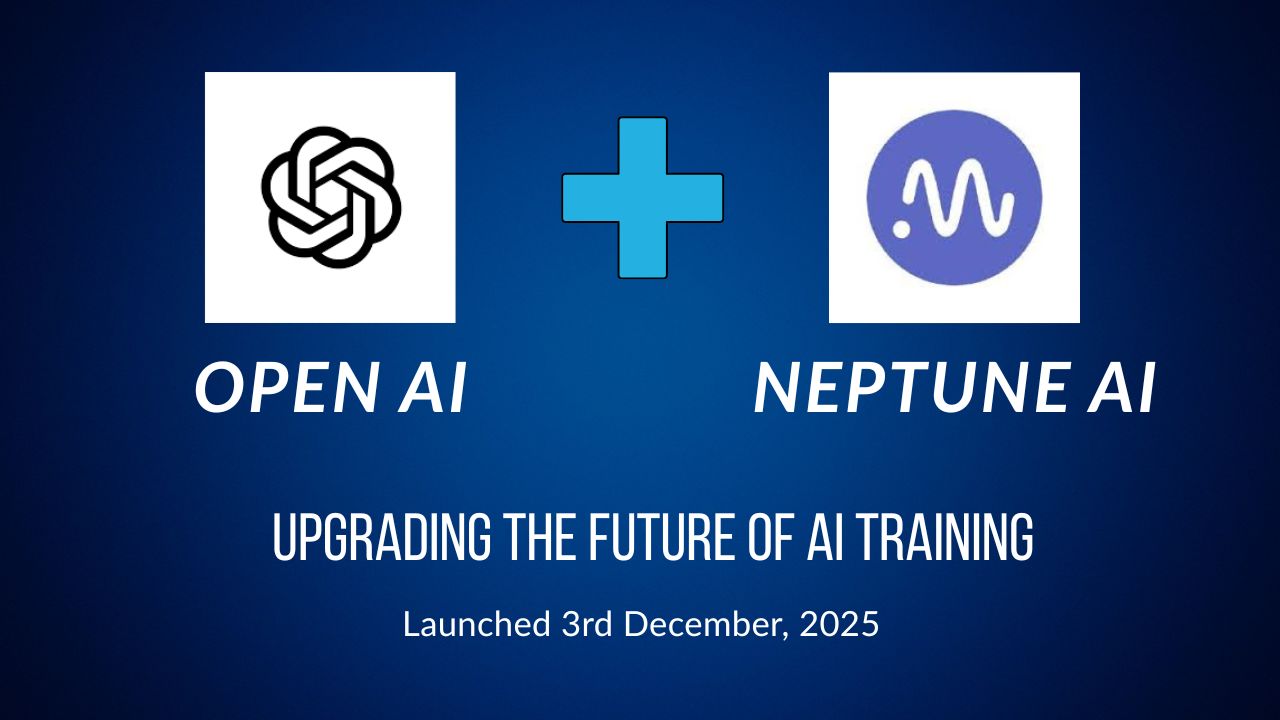
The artificial intelligence world just saw a major move i.e. OpenAI has signed a definitive agreement to acquire Neptune AI, a leading platform used to track and monitor model training for advanced AI development. The acquisition was announced on 3 December 2025.
The move is designed to deepen OpenAI’s visibility into how its frontier models learn and to dramatically speed up experimentation and development.
What happened?
- OpenAI has signed a definitive agreement to acquire Neptune.ai, a startup specialising in tools to track, monitor, analyse and debug AI model training.
- The acquisition means Neptune AI tools and team will be integrated into OpenAI’s internal AI-training infrastructure. Neptune’s standalone services will wind down and the company will stop offering its tools externally by March 2026.
What is Neptune AI?
Neptune AI is a training observability system that helps AI developers to
- Track experiments and version history
- Monitor real-time metrics from model training
- Detect and analyse errors faster
- Manage multiple model configurations
It has served well-known clients such as Samsung, HP, Roche, and even OpenAI. Founded in 2017, Neptune AI became an essential tool for machine learning teams focused on continuous model improvement.
Why OpenAI Decided to Buy Neptune AI?
OpenAI said that Neptune’s tools will help its researchers better understand how complex models learn during training, especially in large-scale AI systems. This will lead to:
- Faster experimentation
- Lower infrastructure costs
- Better real-time visibility
- Higher training reliability
In simple terms, OpenAI will be able to build better models, more quickly.
Key Dates and Deal Details at a glance
Announcement of acquisition
- Neptune AI: blog post “We are joining OpenAI” dated 3 December 2025. Click here
- OpenAI: official blog post “OpenAI to acquire Neptune” published around the same time. Click here
Nature of the deal:
It was a definitive acquisition agreement but the financial terms were undisclosed by OpenAI and Neptune.
Product focus:
It is a training observability platform for foundation models which tracks experiments, metrics, logs, configurations, and model versions during training at scale.
Customer sunset timeline:
The transition period would be from 3 December 2025 till 5 March 2026.
Hosted (SaaS) shutdown: 5 March 2026, 10:00 AM PST
After that, Neptune’s hosted application and API will go offline and remaining hosted data will be deleted.
Read more for OpenAI News Update | ChatGPT Ads Coming Soon | What Users Should Know
What Happens to Existing Neptune AI Users?
Neptune AI will no longer operate as a public service. It will be integrated only inside OpenAI’s systems after 5 March 2026.
So, users are been advised to export their data, migrate to alternatives like MLflow or Weights & Biases and follow Neptune’s step-by-step Transition Hub guides.
Official documentation and support via account managers for self-hosted customers, will be done during the transition.
Also it has communicated that no customer content or personal data will be transferred to the acquirer, hence moving to OpenAI does not mean your data gets imported automatically.
Additionally, Neptune has confirmed that all hosted data will be deleted after shutdown.
How Neptune AI Improves AI Model Training
The platform helps teams to:
- Visualize loss curves & model behaviour
- Compare hundreds of experiments
- Understand reasons behind model degradation
- Debug faster, saving huge computing costs
But, for frontier models, a single mistake can cost weeks and millions and Neptune AI helps to prevent that.
How This Acquisition Helps OpenAI Grow Faster
The acquisition of Neptune AI will help OpenAI make progress much faster in training and improving its advanced AI models. This will help in many aspects such as:
- Faster Experimentation:
Neptune AI helps OpenAI test many ideas quickly, so better models can be built in less time. - Quick Problem Detection:
With real-time monitoring, issues in training can be spotted early, saving huge computing costs and effort. - Better Understanding of Models:
Researchers can clearly see how and why a model is improving or failing, making training smarter and more accurate. - More Secure Development:
By bringing Neptune AI’s tools in-house, OpenAI keeps important data and research fully protected. - Effectiveness increases with higher-capacity models:
As AI systems become larger and more complex, Neptune AI gives OpenAI the strong foundation needed to grow without delays. - Stronger market advantage:
Faster improvements mean OpenAI can roll out new features and products sooner, staying ahead of other AI companies
Impact on the AI Industry
This move highlights a new direction in AI development:
It brings essential AI tools in-house, it reduces reliance on third-party MLOps tools and hence makes AI scale faster and in a more secure way.
Neptune AI going private means its competitive capabilities will now exclusively power OpenAI, strengthening their position in the global AI race.
How This Move Supports AI Safety and Standards
Acquisition of Neptune AI by OpenAI has deeper implications for in terms of AI safety, reliability, and adherence to emerging global standards.
- Better Monitoring and Transparent Training Pipelines
Neptune AI gives teams tools to track experiments, record metrics, watch training progress, and review how a model was built. Instead of running models blindly, this visibility makes it easier to catch issues early, such as unstable training or odd spikes in loss.So it keeps measuring, keep evaluating, and step in quickly when something goes wrong. - Accountability, Auditability & Lifecycle Oversight:
Guidelines like the AI RMF recommend keeping clear records of how AI models are built, from settings and data versions to experiments and performance results.
With Neptune built into OpenAI’s system, every training run is tracked automatically and if a model behaves oddly later, engineers can look back and see exactly how it was created and what changed along the way.
This kind of detailed history is uncommon, and it supports accountability, transparency, reproducibility, and future regulatory needs. - Risk Management and Safer AI Development:
As AI gets more powerful, it can also cause more problems like biased results, strange behaviour, or security issues. So, frameworks like the AI RMF encourage finding and managing these risks early.Neptune helps do this by spotting issues in training, tracking where data comes from, and recording every change. By using Neptune internally, OpenAI builds risk management and transparency directly into its development process.This makes the models safer and more dependable as AI continues to scale and spread. - Setting a Precedent for Responsible AI in the Industry
By buying Neptune AI and building its tools into the core system, OpenAI signals that advanced AI must come with strong monitoring, auditing, and safety checks.
This sets a higher standard for future AI users: real responsibility is it requires clear tracking and constant oversight. Over time, this could push more companies to follow frameworks like the AI RMF or local regulations. That shift can build public trust, improve accountability, and reduce the chances of unsafe or unpredictable AI.
Final Thoughts: The Future After Neptune AI Joins OpenAI
From 3 December 2025, when the definitive agreement was announced, to 5 March 2026, when Neptune’s public services will shut down, the company will be transitioning from an independent MLOps vendor to a core internal engine inside OpenAI’s research stack.
For OpenAI, it’s a strategic investment in speed, reliability, and insight. For Neptune’s customers, it’s a forced but manageable transition. For the wider ecosystem, it’s one more sign that the future of AI belongs not just to those with the most compute—but to those with the best tools to understand what their models are actually doing.
FAQs — Neptune AI & OpenAI
Q1: Will Neptune AI continue as a public platform?
No. All hosted services will be shut down on 5 March 2026.
Q2: What should existing users do?
Export all data and migrate to another tool before the shutdown date. Migration guides are available on Neptune’s transition page.
Q3: Why did OpenAI buy Neptune AI?
To improve its ability to track, analyse, and optimize model training — making AI development faster and more reliable.
Q4: How long is the transition period?
Roughly three months — from December 2025 until March 2026.