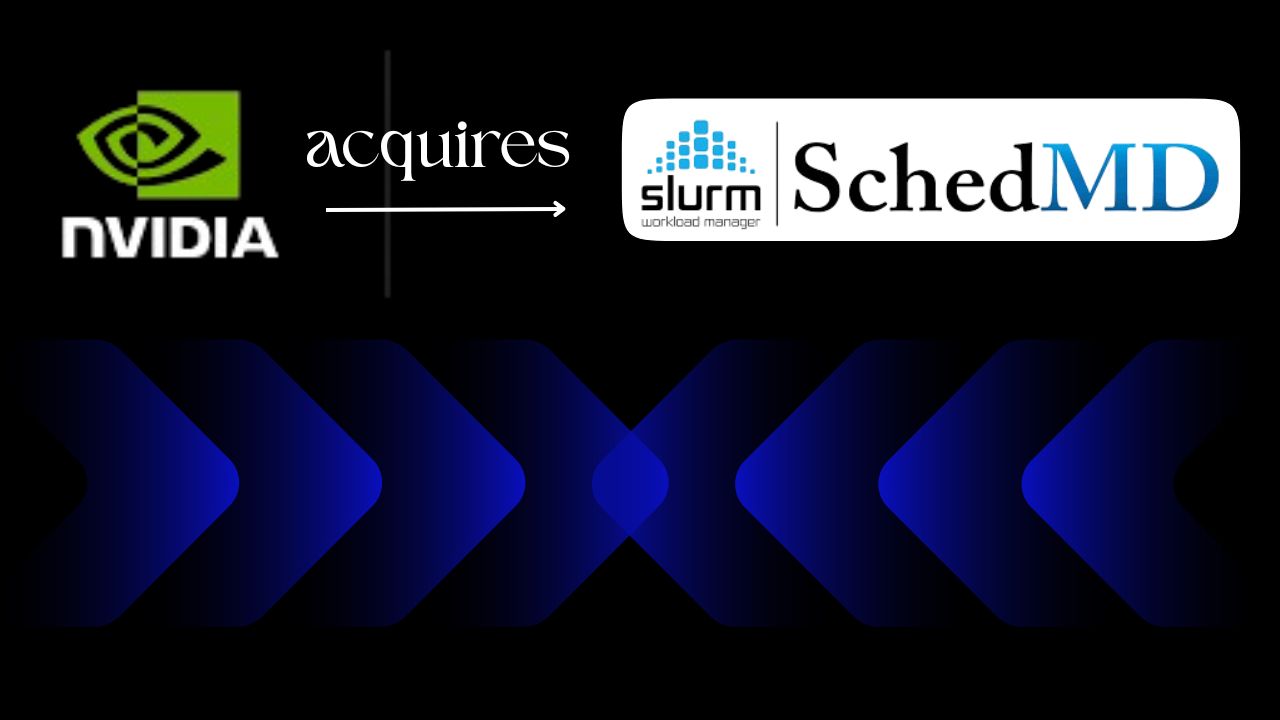
Nvidia has made another quiet but powerful move in its AI journey i.e. Nvidia Acquires SchedMD. In December 2025, the procurement of SchedMD was done, the company behind Slurm, a widely used open-source system that manages massive AI and supercomputing workloads.
While the deal did not grab headlines like flashy product launches, it could reshape how AI infrastructure works behind the scenes. This acquisition signals Nvidia’s growing focus on open-source software, AI scalability, and full-stack control and not just GPUs.
Who Is SchedMD?
SchedMD is a U.S.-based software company best known for developing Slurm (Simple Linux Utility for Resource Management). Slurm is an open-source job scheduler used to manage computing workloads across massive clusters.
It is trusted by supercomputing centres, universities and research labs, AI research teams and enterprises training large AI models
Simply we can say, Slurm decides which AI job runs on which machine, at what time without wasting resources.
Details of Nvidia’s Acquisition
Nvidia officially confirmed the acquisition of SchedMD on December 15, 2025. While the financial terms were not disclosed, Nvidia made it clear that:
- Slurm will remain open source
- Existing users will continue using it freely
- Nvidia will invest in faster development
- Slurm will integrate more deeply with Nvidia’s AI ecosystem
The news was first reported by Reuters, one of the world’s most trusted news agencies, confirming the authenticity of the deal.
Why Nvidia Acquires SchedMD
1. Software Is the New Battleground in AI
Nvidia already dominates AI hardware, but competitors are catching up. Cloud providers, governments, and chipmakers are all developing alternatives. By owning key infrastructure software, Nvidia strengthens its position beyond silicon.
So, SchedMD puts Nvidia in charge of a key coordination layer that connects the hardware to AI software, giving it more control over how everything works together.
2. Strengthening Open-Source Trust
Open-source software is essential for AI research and enterprise adoption. Nvidia has increasingly embraced open source to build trust with developers. By keeping Slurm open source, it avoids lock-in claims while still shaping the direction of a tool.
3. Optimizing AI Workloads for Nvidia Hardware
Slurm already supports Nvidia GPUs, but deeper integration can unlock:
- Better GPU utilization
- Faster AI training cycles
- Improved energy efficiency
- Optimized scheduling for large models
This creates a performance advantage for Nvidia-powered systems without forcing users into proprietary platforms.
4. Supporting the Explosion of AI Clusters
As generative AI adoption grows, companies are building larger and more complex AI clusters. Managing these efficiently is becoming a major challenge.
SchedMD gives Nvidia a direct and early role in tackling this problem on a large scale.
How This Fits Nvidia’s Open-Source AI Strategy
The SchedMD acquisition is not an isolated move. In recent years, Nvidia has:
- Released open-source AI models
- Expanded developer frameworks
- Supported open AI research tools
- Promoted open infrastructure standards
The SchedMD acquisition fits perfectly into this strategy, helping Nvidia remain central to AI development even as governments and enterprises push for open and sovereign AI systems.
Impact on Developers and Researchers
For developers and researchers, the acquisition brings both reassurance and opportunity.
Key Benefits:
- Slurm remains free and open source
- Faster feature development backed by Nvidia resources
- Better documentation and enterprise support
- Improved performance for AI workloads
Many in the open-source community initially worry when large corporations acquire critical tools. When Nvidia Acquires SchedMD, Nvidia’s commitment to keeping Slurm open source helps ease those concerns.
Impact on Enterprises and Cloud Providers
Enterprises running large AI workloads may benefit from:
- More reliable AI infrastructure
- Improved GPU utilization (lower costs)
- Better scalability for AI training and inference
- Stronger long-term support
Cloud providers already using Slurm may also benefit from tighter integration with Nvidia’s AI stack.
Read more for details on First OpenAI Certification Courses launched
Government and Public Sector Angle
There is no direct government approval announcement linked to this acquisition, as it falls under standard corporate transactions. However, Slurm is widely used in government-funded supercomputers and research institutions.
Because of this, Nvidia’s promise to keep Slurm open source is especially important for public-sector trust and transparency.
Impact on Indian Startups and AI Labs
Indian AI startups often operate with limited infrastructure budgets. Slurm helps them:
- Maximize GPU usage
- Reduce idle computing time
- Scale AI training efficiently
With Nvidia backing Slurm’s development, startups building AI in healthcare, fintech, language models, and computer vision stand to benefit from improved performance and reliability.
Benefits for Indian Universities and Research Institutes
India’s top universities and national labs rely heavily on open-source tools. Since Slurm is already used in global supercomputing environments, Nvidia’s move provides reassurance that:
- The tool will remain free and open
- Academic research workflows will remain uninterrupted
- AI research can scale without proprietary lock-ins
This aligns well with India’s push for digital self-reliance.
Risks and Concerns
Despite the positives, some concerns remain:
- Open-source independence in the long term
- Potential prioritization of Nvidia hardware features
- Community governance transparency about corporate influence
Nvidia will need to actively engage with the open-source community to maintain credibility.
What This Means for the Future of AI
This deal of Nvidia Acquires SchedMD signals a bigger trend: AI leadership now depends on software as much as hardware. Nvidia is no longer just a chip company, it is becoming an AI platform company.
By controlling hardware, networking, scheduling, and software, Nvidia is positioning itself at the very core of the AI revolution.
Conclusion
Nvidia Acquires SchedMD is a strategic move that strengthens its open-source AI foundation while expanding its control over AI infrastructure. By keeping Slurm open source and investing in its growth, Nvidia balances business goals with community trust.
This acquisition shows that the future of AI will not be built on hardware alone, it will also be built on smart, open, and scalable software ecosystems.
FAQs
Q1. What is SchedMD known for?
SchedMD is the creator of Slurm, an open-source workload management system used in AI and supercomputing environments.
Q2. Will Slurm remain open source after Nvidia Acquires SchedMD?
Yes, Nvidia has confirmed that Slurm will remain open source.
Q3. Why did Nvidia acquire SchedMD?
To strengthen its AI software stack and improve AI workload management, Nvidia Acquires SchedMD
Q4. Does this affect existing Slurm users?
No negative impact has been announced. Users can continue using Slurm as before.
Q5. How does this help AI development?
It improves GPU efficiency, scalability, and performance for large AI workloads.
Q6. Why is Nvidia’s acquisition of SchedMD important for India?
Because Slurm is widely used in AI research and supercomputing, and Nvidia’s support strengthens its future.
Q7. How does this help Indian AI startups?
It improves GPU efficiency, lowers infrastructure waste, and supports scalable AI training.
Q8. Does this impact government AI projects in India?
Positively. Many government and academic projects rely on open-source tools like Slurm.