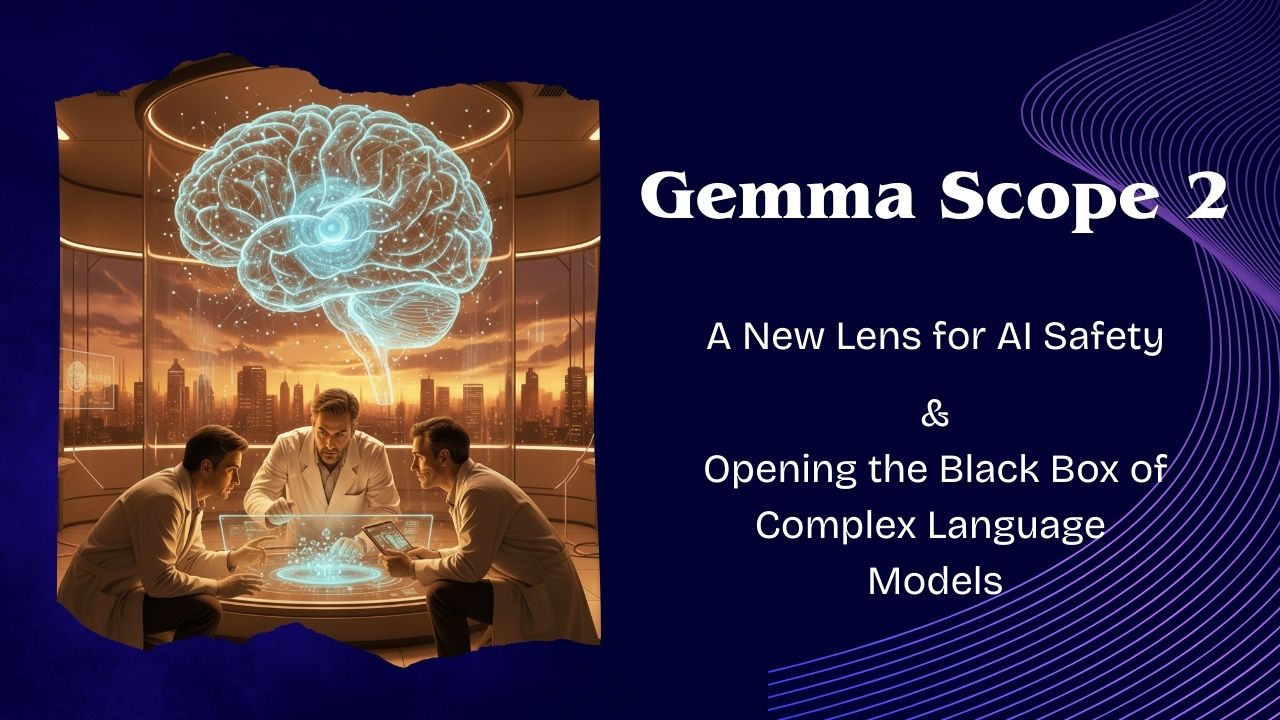
Gemma Scope 2 is changing how researchers understand what happens inside powerful language models. As AI systems is evolving faster than ever and becoming more capable and widely used, questions about safety, trust, and transparency are growing louder. Many models still behave like black boxes, offering impressive answers without clearly showing how they reached them.
Launched by Google DeepMind, Gemma Scope 2 is a powerful open-source interpretability toolkit which addresses this challenge by giving the AI safety community tools to look inside a model’s internal thinking process. It helps researchers’ study how ideas, decisions, and even mistakes form within complex language models. By making AI behaviour more visible and explainable, Gemma Scope 2 plays an important role in building safer, more reliable, and more trustworthy AI systems for the future.
Why Understanding AI Behaviour Matters
Modern language models are capable of writing essays, coding software, and answering complex questions. However, they can also hallucinate facts, break safety rules, or behave unpredictably at scale.
Without understanding why these behaviours happen, fixing them becomes guesswork. Gemma Scope 2 directly addresses this challenge by giving researchers tools to analyze how concepts, reasoning patterns, and decisions are formed inside AI models.
For AI safety, this is not optional, it is essential.
What Is Gemma Scope 2?
Gemma Scope 2 is an open interpretability suite built for the Gemma 3 family of language models. It provides researchers with structured tools to study internal activations, concepts, and computations across different layers of a model.
In simple terms, it helps answer questions like:
- What concepts does the model activate while responding?
- Which internal signals lead to unsafe or incorrect outputs?
- How does reasoning evolve across model layers?
What Makes Gemma Scope 2 Different?
Gemma Scope 2 builds on earlier interpretability research but goes much further in scale and usability.
Key improvements include:
- Coverage across all Gemma 3 model sizes, from small to very large models
- Use of sparse autoencoders, which isolate meaningful internal features
- Transcoders that help trace multi-step reasoning across layers
- Open access for researchers, startups, and academic institutions
This combination makes Gemma Scope 2 one of the most comprehensive open AI interpretability releases to date.
How Sparse Autoencoders Help Explain AI
Sparse autoencoders break down dense internal model activations into simpler, human-understandable features. Each feature often represents a concept, pattern, or signal the model relies on.
For example, a feature may activate for:
- Mathematical reasoning
- Names of countries
- Safety-related refusals
- Emotional language
By analysing these features, researchers can see exactly what influences a model’s response.
Understanding AI Safety Issues with Gemma Scope 2
Gemma Scope 2 is especially valuable for studying safety-related behaviours such as:
Hallucinations: Researchers can identify internal features that activate when the model generates false or made-up information.
Breakout Attempts: The tools help trace how a model processes prompts that attempt to bypass safety restrictions.
Alignment and Refusals: It allows analysis of how refusal mechanisms are triggered internally and whether they function consistently.
Know more on Google Gemini 3 Flash AI Mode Rolls Out Globally: What It Means for Search Users
Why This Matters for AI Governance
AI regulation and governance often struggle due to lack of transparency. Tools like this can help bridge that gap by offering measurable, inspectable evidence of how models behave internally.
This supports:
- Better AI audits
- More reliable safety evaluations
- Transparent reporting for regulators
Open Research and Community Impact
One of the strongest aspects of Gemma Scope 2 is that it is open to the research community. By releasing the tools publicly, Google DeepMind enables independent verification, experimentation, and collaboration.
This openness encourages:
- Reproducible safety research
- Faster identification of risks
- Shared standards for interpretability
Sources :
The project is officially released by Google DeepMind, and its authenticity comes from:
- DeepMind’s official blog. Read the official DeepMind blog
- Technical research papers. Download the Gemma Scope 2 technical paper(PDF)
- Public repositories and documentation. Explore Gemma Scope 2 tools on Hugging Face , Official Gemma Scope 2 documentation on Google AI Dev site
However, such tools may later influence government-led AI audits and policy frameworks.
The Bigger Picture: A Step Toward Trustworthy AI
Gemma Scope 2 does not claim to solve all AI safety problems—but it significantly improves our ability to understand them. Transparency is the foundation of trust, and this project pushes the industry closer to explainable and accountable AI systems.
As AI models grow more capable, tools like this will be critical in ensuring they remain aligned with human values and societal needs.
FAQs
Q1. What is Gemma Scope 2?
It is an open AI interpretability toolkit by Google DeepMind that helps researchers analyse internal behaviour of language models.
Q2. Who can use Gemma Scope 2?
AI researchers, safety teams, academic institutions, and developers working with Gemma models can use it.
Q3. Why is Gemma Scope 2 important for AI safety?
It helps identify how unsafe or incorrect behaviours emerge inside language models, enabling better fixes and safeguards.
Q4. Does Gemma Scope 2 work on all AI models?
No, it is designed specifically for the Gemma 3 family of language models..
Q5. Is Gemma Scope 2 open source?
Yes, it is publicly released to support open and collaborative AI safety research.