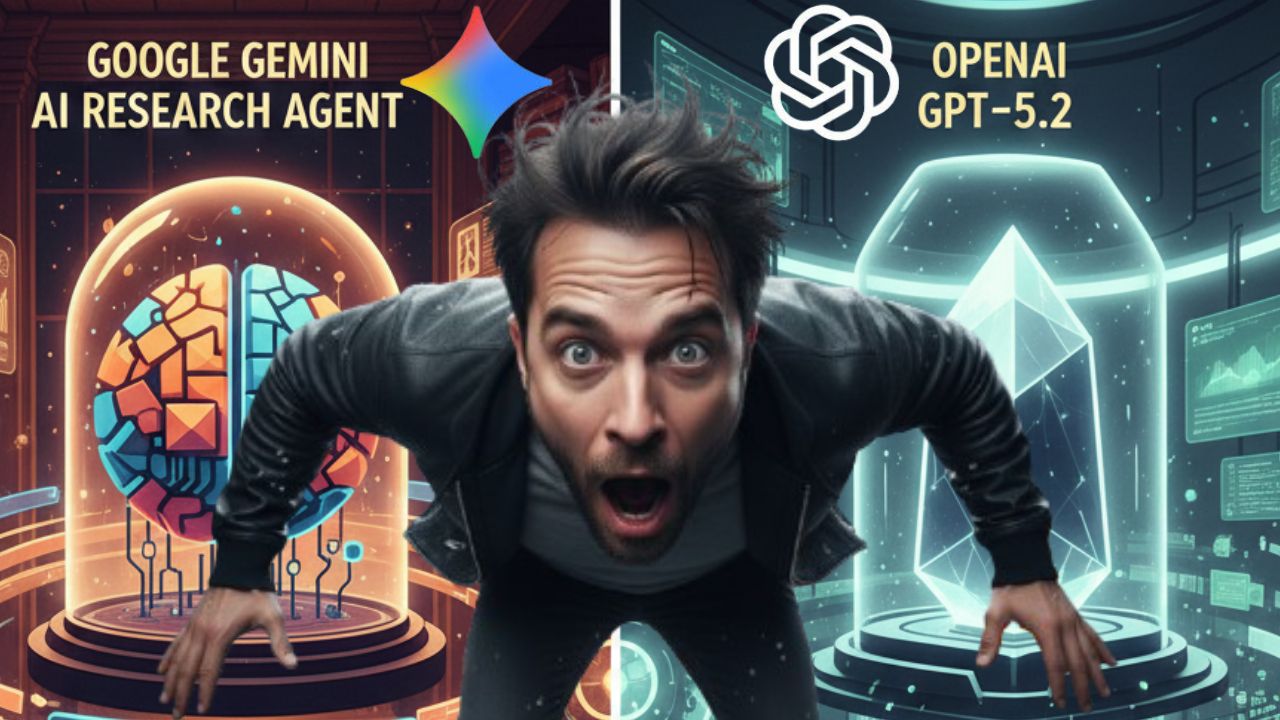
December 11, 2025, will be remembered as a landmark day in artificial intelligence. On the very same day, Google launched its deepest AI research agent yet, while OpenAI released GPT-5.2, its newest and most advanced language model.
The timing was not accidental it highlighted the intense competition between the world’s two biggest AI companies. Both announcements focused on one clear goal: making AI smarter, more useful, and capable of handling real research and professional work.
Now let’s find out what each company launched and how this changes the future of AI.
Google’s Deepest AI Research Agent: What’s New?
Google introduced an upgraded version of Gemini Deep Research, calling it its most advanced research-focused AI so far.
Unlike normal chatbots, this AI agent is designed to research deeply, analyse information from multiple sources, and present structured insights.
Key Capabilities of deepest AI research agent
- Handles very large information inputs like documents, reports, emails, and datasets
- Performs multi-step reasoning, not just quick answers
- Creates structured research outputs such as summaries, comparisons, and reports
- Integrates with Google tools like Search, Drive, Gmail, and Docs (with permission)
This AI is built on Gemini 3 Pro, Google’s latest foundation model, which improves accuracy, reasoning, and factual consistency.
Google with Gemini Deep Research Agent.Read here
Built for Developers and Businesses
Google also opened access through its Gemini API and Interactions API, allowing developers to embed this research agent directly into their own apps and platforms.
This makes it useful for:
- Researchers and analysts
- Journalists and content teams
- Legal and financial professionals
- Students and educators
Google’s focus is clear: AI that works deeply inside real workflows, not just casual conversation.
OpenAI GPT-5.2: A Major Leap Forward
On the same day, OpenAI launched GPT-5.2, positioning it as its most capable model for professional and enterprise use.
GPT-5.2 builds on earlier GPT-5 versions and brings noticeable improvements in reasoning, long-context understanding, and complex task execution.
Key Improvements in GPT-5.2
- Stronger reasoning and problem-solving
- Better performance on math, science, and coding tasks
- Ability to handle very long documents and workflows
- Improved agentic abilities, meaning it can plan and execute multi-step tasks
OpenAI also introduced different variants like:
- Instant (faster responses)
- Thinking (deeper reasoning)
- Pro (enterprise-grade workloads)
This makes GPT-5.2 suitable for software development, data analysis, research and experimentation and business automation.
Why the Same-Day Launch Is Important
The same-day release shows how intense the AI race has become.
Google’s Strategy
- Focus on deep research and structured analysis
- Strong integration with existing Google products
- Emphasis on real-world productivity and knowledge work
OpenAI’s Strategy
- Push the frontiers of reasoning and intelligence
- Build AI that can act as a long-running agent
- Strong focus on enterprise and professional use cases
Both approaches are different, yet they aim for the same outcome:
What This Means for Users
1. For Researchers & Students: Research that once took days can now be done in hours. However, human verification is still essential.
2. For Developers: Both Google and OpenAI are making it easier to build advanced AI-powered apps faster than ever.
3. For Businesses: AI is moving from “support tool” to “core productivity engine,” changing how companies operate.
DeepSeek AI vs Open AI vs Google : Who Wins the 2026 AI Race? Read here for details
Final Thoughts
The launch of Google’s deepest AI research agent and OpenAI’s GPT-5.2 on the same day i.e. December 11, 2025 marks a turning point in artificial intelligence. It makes AI genuinely useful for complicated, real-world work.
For professionals and organizations, that’s an exciting promise: faster research, better synthesis, and automation of tedious multi-step tasks. For society, it’s a reminder that rapid capability gains must be matched by careful verification, governance, and responsible deployment.
If you’re a developer, product manager, or researcher excited by these tools: test conservatively, instrument aggressively, and design for human verification. The overnight improvements are impressive but the job of building trustworthy, transparency, and human oversight remain essential.
FAQs
Q1. What is Google’s deepest AI research agent?
It is an advanced version of Gemini Deep Research designed for complex research, analysis, and structured outputs.
Q2. What is GPT-5.2?
GPT-5.2 is OpenAI’s latest AI model with improved reasoning, long-context understanding, and professional capabilities.
Q3. Are these tools free to use?
Some features may be available for free, while advanced capabilities require paid plans or enterprise access.
Q4. Which is better: Google’s agent or GPT-5.2?
Google focuses more on deep research and integration, while OpenAI focuses on advanced reasoning and agent intelligence.
Q5. Can businesses use these tools securely?
Yes, both companies offer enterprise solutions with data privacy and security controls.
Q6. Do these AI tools replace human researchers?
No. They assist humans but still require verification and judgment..
Q7. Is there any government approval required?
Currently, no specific approval is required, but users must follow data protection laws.
Q8. Will this impact jobs?
It will change workflows, reduce repetitive tasks, and create new AI-related roles.