Artificial Intelligence has been the world’s biggest conversation in 2025, touching every industry and influencing global politics, creativity, and daily life. So, when TIME magazine announced “The Architects of AI” as its 2025 Person of the Year, it wasn’t just a recognition, it was a statement. A statement about how deeply AI builders have shaped our world.
This article breaks down who these architects are, why TIME chose them, and what this honour means for the future of technology and society.
What Does “Architects of AI” Really Mean?
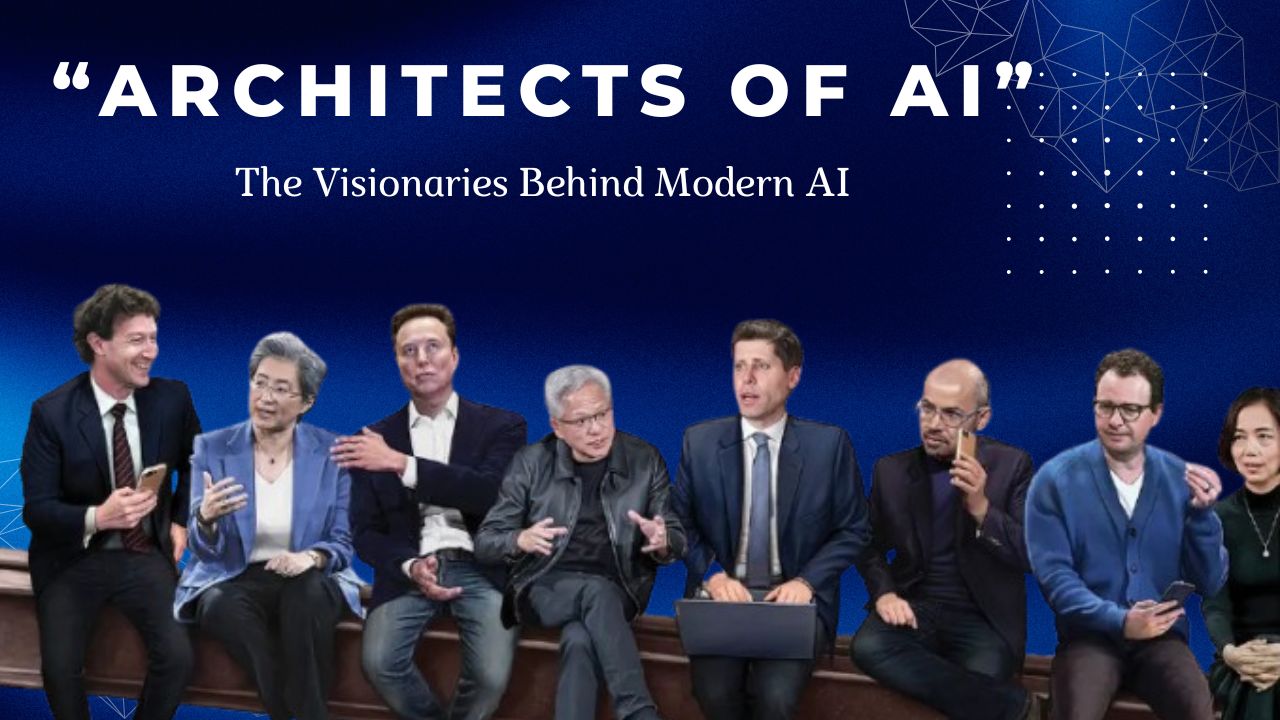
Instead of selecting one influential individual, TIME chose a group representing the engineers, founders, researchers, designers, and hardware creators who built today’s AI revolution.
These people imagined the tools we now use daily starting from chatbots to advanced robotics to generative AI models.
Who are the AI architects?
TIME’s cover symbolically highlights leaders who represent different pillars of AI. The Faces Representing the Movement are:
- Sam Altman (OpenAI): advanced consumer AI adoption
- Jensen Huang (Nvidia): hardware backbone of AI
- Demis Hassabis (Google DeepMind): research & scientific AI
- Dario Amodei (Anthropic): safety and aligned AI
- Lisa Su (AMD): chip innovation
- Mark Zuckerberg (Meta): expanding open-source models
- Elon Musk (xAI): alternative approaches to general AI
- Fei-Fei Li: pioneering research and human-centred AI
These individuals symbolize thousands of people who built today’s AI ecosystem.
“The Architects of AI Are TIME’s 2025 Person of the Year” : TIME
Why TIME Honoured Them in 2025
2025 became a defining year for AI because:
- AI adoption reached every sector
- Chipmakers advanced historic breakthroughs
- AI entered politics, legal systems & creative industries
- Governments launched national AI strategies
- New safety and ethical challenges surfaced
The influence of AI evolved from being “tech news” to shaping global decision-making.
The Positive Impact of AI’s Architects
The innovations made by Architects of AI led to faster scientific research, medical breakthroughs, better productivity tools, smarter infrastructure, more creative freedom for artists and individuals, economic growth and creation of new job categories
So, AI became every day partner, not just a machine.
The Concerns That Comes with Power
Great influence of AI comes with even greater responsibility.
TIME’s choice highlights the key concerns surrounding AI today, including worries about protecting personal data, the possibility of people losing jobs, debates over fairness and bias, the dangers of highly capable systems, and the growing problem of misinformation and deepfakes.
Governments Step In: Policies & Regulations
2025 saw governments worldwide release AI frameworks, including the U.S. “AI Action Plan” and similar strategies in Europe and Asia. However, these policies aim to:
- Support AI innovation
- Build secure and ethical AI systems
- Ensure global competitiveness
- Protect citizens from risks
Governments now recognize AI as a strategic national asset.
For example,
India is actively creating rules to guide the safe and responsible use of AI. The government launched the IndiaAI Mission, a national program to build large AI models, high-power compute resources, and datasets for startups and researchers. India also passed the Digital Personal Data Protection (DPDP) Act, which ensures that AI systems handle personal data safely and with user consent. Along with this, the Ministry of Electronics and IT introduced Responsible AI guidelines to prevent bias and misuse. These steps show how India is promoting innovation while protecting citizens in an AI-driven future.
Looking Ahead: The Future AI Architects Will Build
We’re entering a decade where AI may:
- Cure diseases faster
- Personalize education
- Advance climate science
- Transform transportation
- Reshape global economies
- Push the boundaries of creativity
So, we can say AI advanced faster than ever, with creative tools becoming far more powerful, robots and automated systems entering everyday life, and breakthroughs speeding up healthcare and medicine. It also transformed creative work from pictures and movies to games and changed how software is built through smarter coding tools.
2025 was the year AI became impossible to ignore.
TIME’s selection marks the beginning of a new era, the one which has been built by the Architects of AI.
Meta acquires Limitless: A Big Move in AI Wearables.Read here for details
FAQs:
Q1. Who are the “Architects of AI”?
Architects of AI are the CEOs, founders, researchers, hardware innovators and pioneers who built the modern AI systems used across the world today.TIME’s magazine focuses on a few well-known names as examples, Jensen Huang (Nvidia), Sam Altman (OpenAI), Demis Hassabis (DeepMind), Dario Amodei (Anthropic), Elon Musk (Tesla/X), Mark Zuckerberg (Meta) Lisa Su (AMD),and also a researcher Fei-Fei Li.
Q2. Why did TIME choose them as Person of the Year?
Because AI shaped global news, politics, business, scientific breakthroughs, and everyday life more than any other force in 2025.
Q3. Did TIME award one specific person?
No. The title represents a group rather than an individual, symbolizing the entire AI ecosystem.
Q4. How does this decision affect the tech world?
It increases accountability, encourages ethical AI development, and highlights the massive influence technology leaders hold.
Q5. What does this mean for the future of AI?
It signals that AI will continue to grow, shaping industries, governments, and personal lives more profoundly in the coming decade.