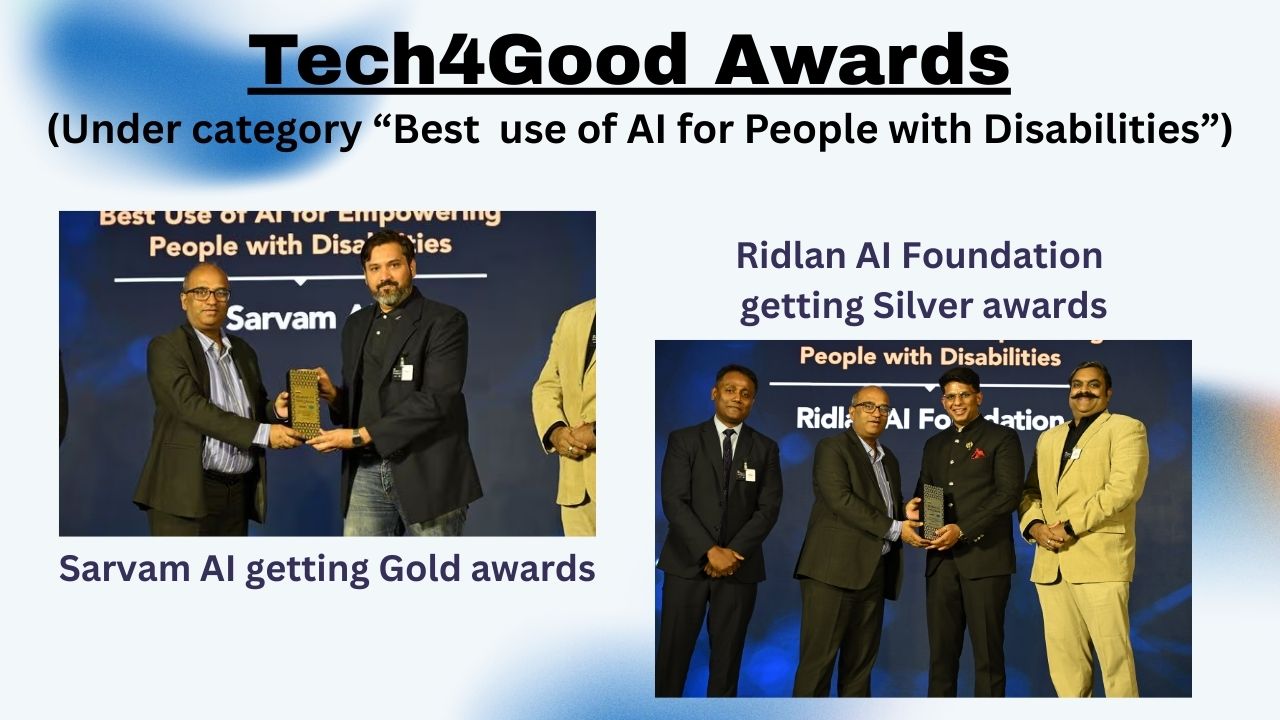
Sarvam AI and Ridlan AI Foundation are recognized for using AI to empower people with disabilities in India.
Imagine a world where technology becomes truly powerful and it improves lives. Where artificial intelligence doesn’t just serve those who are tech-savvy, but quietly empowers those often left behind. That’s exactly what Sarvam AI and Ridlan AI Foundation are doing. Recently, they were honoured at the Mint All About AI Tech4Good Awards for their efforts to make life easier and fairer for people with disabilities in India.
What Are the Tech4Good Awards and who organized it?
The honours were presented at the “Mint All About AI Tech4Good Awards & Summit 2025”.
- The event brought together policymakers, founders, technologists and impact organisations to discuss how AI can be used responsibly for social good.
- The “Best Use of AI for Empowering People with Disabilities” category specifically looks at projects that enhance accessibility, independence and quality of life for differently-abled individuals.
- Winners are selected based on impact, innovation, scalability and responsible use of AI.
According to coverage by Mint and Hindustan Times, Sarvam AI was selected as the Gold winner and Ridlan AI Foundation as the Silver winner in this category.
Why This Award Matters in India
India has nearly 2.6 crore of people living with disabilities, many of whom face daily struggles in accessing public services, education, employment, or even simple digital tools.
Despite technological progress, most global AI tools are built keeping in mind, the users using English as the primary language or users staying in western countries. But they generally tend to leave people who speak Indian languages or need assistive tools, which is a disadvantage.
The “Empowering People with Disabilities” category at the Tech4Good Awards was created to highlight and encourage AI solutions for these often-overlooked communities.
By awarding Sarvam AI (Gold) and Ridlan AI Foundation (Silver), the judges acknowledged that they are helping solve these problems using modern AI solutions.
Sarvam AI: AI That Speaks Like India
Sarvam AI is a home-grown startup focusing on building advanced AI models mainly taking into account the Indian languages and Indian needs. Instead of assuming everyone is comfortable with English, Sarvam trains AI to understand, speak, and assist in languages familiar to millions across India.
What does Sarvam AI do and how it helps People with Disabilities
The Tech4Good jury recognised Sarvam AI for using its multilingual generative AI platform to power conversation agents across 11 Indian languages, thus making digital services more inclusive.
Click here for reference
Here’s how this translates into real-world benefits:
Multilingual Assistive Tools
Sarvam AI builds speech and text tools in Indian languages, enabling people to interact comfortably without English as a barrier. Its text-to-speech system creates natural, easy-to-listen voices, which helps a lot for people with visual impairment.
Inclusive Access to Digital Services
Most of digital platforms in India today, remain hard to use for persons with disabilities. Sarvam AI’s technology can layer over these platforms, helping users navigate options using voice or simple language. This kind of accessibility helps people who might struggle with reading, typing, or even understanding complex digital menus.
Affordable and Scalable Solutions
Because Sarvam AI targets Indian languages and context, it can enable affordable assistive tools built by small startups or NGOs. This helps bring accessibility to rural areas, smaller towns, and to users who can’t afford expensive proprietary software.
By focusing on “AI that speaks like India,” Sarvam AI is helping democratize access to technology, especially for those people who need that help the most.
Ridlan AI Foundation: Technology That Reunites Families
Ridlan AI Foundation is a social-impact organisation using AI for humanitarian purposes. Their key project, Milab Setu AI, aims to reunite missing persons, including people with disabilities or the elderly — with their families.
How Their Work Makes a Difference
Milab Setu AI uses facial recognition and matching algorithms to scan photos and CCTV or database images for missing individuals. This dramatically reduces the time it takes to trace missing people. For people with mental health conditions, cognitive disabilities, or visual/hearing impairment or people who may not be able to communicate properly, this tool can be a lifeline for them.
By offering dignity, hope, and a chance to reconnect, Ridlan AI Foundation shows how AI can be used for real human impact, not just business.
Impact of Their Work
- Faster identification of missing and lost individuals
- This shows support for families and social workers
- This also helps to restore dignity, safety, and belonging
What these Awards Means for India?
- Inclusion Is Becoming a Priority
Awards like this shift the narrative that: AI doesn’t have to be just about profit or fancy automation. It can and should be about inclusion, dignity, and accessibility. - Technology is for All
Solutions like Sarvam AI’s help make technology usable by far more people,especially those who are often left out because of language or disability. That expands reach by millions. - Encouraging Responsible Innovation
Recognition from major platforms like this encourages more startups, NGOs, and developers to think about people with disabilities from the very start i.e. designing tools that serve everyone, not just a tech-savvy people. - Bridging Policy and Reality
While laws and policies like the Rights of Persons with Disabilities (RPwD) Act aim for inclusion, technology like this brings these rights to life by building actual accessible tools.
What More Can Be Done
- Integrate with Government Services: Tools from Sarvam AI or Ridlan AI could be integrated into public portals, helplines, welfare schemes, helping people with disabilities access services more easily.
- Open-Source and Collaboration: If models and tools are shared openly, more innovators can adapt them to local needs — in different languages, rural areas, or niche disability communities.
- Awareness and Training: People, NGOs, social workers need awareness about these tools. Training and outreach can ensure the tools are actually used by those who need them most.
- Design Access from the Start: New websites, apps or public systems should be designed for accessibility from the start — not retrofit later for inclusion.
Conclusion
Sarvam AI and Ridlan AI Foundation are proving that when AI is used thoughtfully, it can become a powerful force for inclusion, dignity, and social good. By focusing on accessibility, they are making technology more human and helping India become a place where everyone can participate fully in digital life.
Sarvam AI demonstrates that it’s possible to build world-class AI that understands India — our languages, our contexts, our people. Ridlan AI Foundation shows that AI can help the most vulnerable find their way home.
In India, if we continue on this path of combining technology with empathy, innovation with inclusion it won’t just be about breakthroughs. It will be about belonging.
This is AI for good. This is AI with heart.
Amazon AI: Announced US $12.7 billion Investment to Transform India’s Digital Future by 2030. Read here for info
FAQs
Q1. What is Sarvam AI?
Sarvam AI is an Indian AI company focused on building language models and assistive technologies for Indian users, especially those who speak regional languages.
Q2. How is Sarvam AI helping persons with disabilities?
By offering voice and text technology in Indian languages, Sarvam AI helps people with visual or learning disabilities access digital services more easily.
Q3. What does Ridlan AI Foundation do?
Ridlan AI works on AI solutions that help missing and vulnerable individuals return to their families safely.
Q4. What are the Tech4Good Awards?
They are awards recognising AI projects that create positive social impact in India, especially in areas like disability support and inclusion.
Q5. Why is accessibility important in technology?
Because everyone deserves equal access to services, information, and opportunities — including people with disabilities.