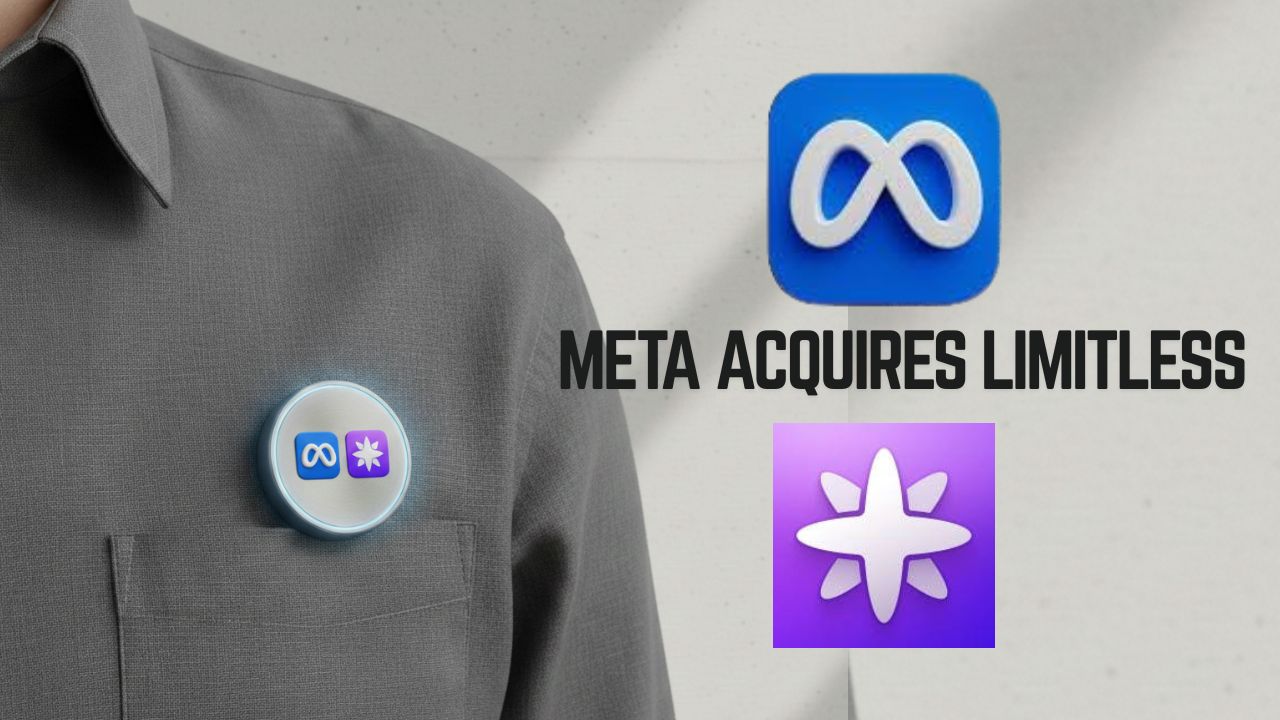
Meta news just got interesting. On December 5, 2025, Meta acquires Limitless, the startup behind a clever AI-powered wearable devices or a tiny pendant that records and summarizes real-world conversations. The acquisition marks another bold step by Meta into the world of AI hardware.
In simple terms, Meta is trying to give you a tiny “memory assistant” you wear, which quietly listens, records, and help you remember the details of your day.
What is Limitless and what does it do?
Limitless makes a small wearable, a pendant that clips onto your clothes or you can hang around your neck. This pendant quietly listens to real-world conversations, with consent and then sends the audio to a companion app.
Subsequently, the application uses AI to transcribe, summarise, and index your conversations and then letting you search your past discussions like a personal memory archive.
For mainly the users, this means being able to recall what was said in meetings, remember important details from conversations, or quickly retrieve past dialogs. It is very useful for professionals, students or anyone managing many tasks at a time.
Meta acquires Limitless: The Deal and Deal Details
- On December 5, 2025, Meta acquires Limitless officially. The deal was announced via a blog post by Limitless’ Co-Founder & CEO, Mr. Dan Siroker and henceforth confirmed by major media outlets.
- Meta did not disclose the financial terms of the deal.
- Limitless co-founder and CEO said the acquisition aligns with “Meta’s vision to bring personal superintelligence to everyone.”
Changes for existing Users After Meta acquires Limitless
The acquisition brings a mix of good news and uncertainty for existing and potential users of the Limitless pendant.
- Limitless will no longer sell pendant devices to new customers
- As Meta acquires Limitless, existing customers will get continued support, Meta said it will maintain services for at least a year.
- The older desktop applications by Limitless, previously known as “Rewind”, which recorded screen and audio on computers is being discontinued
That means if you were planning to buy one, the opportunity may have passed , unless Meta chooses to re-release an updated version.
Why Meta acquires Limitless : The Strategic Push
Meta has recently signalled a shift in focus away from largely speculative “metaverse” efforts toward AI-enabled consumer hardware, including wearable devices.
This acquisition lines up with Meta’s changing priorities
A. Turning to AI Wearables & “Personal Superintelligence”
- Meta acquires Limitless as it wants to build AI-enabled hardware, not just social media or virtual-reality headsets. The purchase of Limitless helps them expand into “always-with-you” AI devices.
- Wearable pendants like Limitless, along with smart glasses and rings are part of a growing trend in “ambient AI”. It is a technology that quietly runs in the background and helps you without needing a screen.
B. Expanding the Hardware Portfolio
- Meta already has smart-glasses partnerships earlier with brands like Ray-Ban and Oakley. But after Meta acquires Limitless,it adds a pendant form factor in its product base which is small, unnoticeable and wearable by anyone.
- This broadens Meta’s “wearable hardware stack,” allowing them to target users who may not want or need a full pair of smart glasses.
C. Competing in the Broader AI Devices Race
- The AI wearables space is becoming competitive, with many startups building rings, pendants, smart glasses, and audio-based companions.
- By bringing Limitless in-house, Meta can use its resources to design, AI infrastructure, user base and subsequently try to lead this emerging category
Privacy, Consent & Concerns
Wearable devices that record conversations all day raise tough questions. What about consent and what about others around who didn’t give permission to be recorded?
Critics argue that “always-listening” wearables, even if marketed for productivity or memory aid can blur the boundaries between convenience and privacy invasion. People might feel pressurised to what they say or be recorded without clearly agreeing to it.
Even as Limitless had features like “Consent Mode,” which aimed to capture only voices of people who agreed to be recorded, many experts worry about how real-world use will respect privacy, especially in shared spaces like offices, cafés or public transport.
However, now since Meta acquires Limitless and integrates it’s technology into its broader ecosystem, ethical and regulatory scrutiny may increase by making this a key issue to watch out for.
The Bigger Trend: Ambient AI Wearables in 2026
The acquisition of Limitless comes at a time when the market for ambient AI wearables is heating up. More startups and established firms are exploring devices like smart rings, pins, glasses, and pendants all designed to make AI subtle, always-accessible, and deeply personal.
Meta’s move shows that ambient AI isn’t a fringe idea. It may well become part of mainstream everyday life i.e. from meetings to personal notes, from reminders to memory recall.
How Limitless Compares with Other AI Wearables
Compared with smart glasses or bulky headsets:
- Pendants like Limitless are light, discreet, and familiar, very much similar to all those everyday accessories people use.
- But this convenience comes along with privacy concerns, potential social awkwardness, and regulatory uncertainty which remains much higher.
Potential Challenges: Design, Ethics, Privacy, Adoption
Even with the acquisition, the success of Limitless’s technology under Meta isn’t guaranteed. Some of the challenges include:
- User trust and privacy: Getting people to accept always-on recording in their lives and to respect consent requirements of others.
- Regulatory scrutiny: Laws in many countries may limit continuous recording, especially in public or shared spaces.
- Adoption & social comfort: People may resist wearing devices that look like a recorder or body camera.
- Integration & future-planning: Meta must integrate this tech into its ecosystem in a way that is sustainable, secure, and offers real value beyond its uniqueness.
Meta acquires Limitless: Impact on everyday users
If Meta uses this in right way, and addresses the problems surrounding privacy & consent carefully, wearable AI could drastically change how we work, remember, and organize information.
- It can help users by always remembering a meeting’s key points.
- Summarizing long conversations or lectures instantly.
- It can be your personal AI assistant that lives in your pendant that is always ready and always listening to help you out, of course with your consent.
But if mismanaged, this could also lead to discomfort, self-control, and serious privacy dilemmas.
Effect on Indian Users:
Meta acquires Limitless means India could soon see more advanced AI wearables entering the market.
- Meta has already launched AI-powered smart glasses in India with Hindi language support, so integrating Limitless technology like memory assistance, meeting summaries, and searchable conversation features could become a reality here as well.
- For students, working professionals, and content creators, this could be very useful. You may have a tiny device that remembers everything important, helps in multitasking, and gives quick summaries without needing a phone or taking notes.
However, there will also be privacy concerns.
Devices that record voice or conversations must follow India’s data protection law, and users will need to inform others before recording. Everyday situations like offices, schools, or even cafés may become tricky if people feel they are being recorded. India’s regulators may place restrictions or require stronger consent rules before such wearables become common.
So, while this move could bring exciting new technology to India, it also demands responsible usage and clear privacy safeguards to make users feel safe and confident.
Also read OpenAI Acquires Neptune AI: A Major Step Toward Faster AI Development : Click here
Should You Care, or Be Concerned?
If you care about productivity, forgetfulness, or simply experimenting with new technologies, wearable AI might look exciting. But it’s also important to think carefully about some things.
For example:
- Always ask: who else is being recorded?
- Always check: what data is stored, where, and who can access it?
- Always consider: are you comfortable living an “always-on” life?
For some people, this may feel like a super convenience. For others, it might feel like surveillance all the time.
Conclusion:
Meta’s acquisition of Limitless is a signal that AI is moving into our daily lives not just through phones or apps, but through wearables that always stay with us.
Whether that future becomes amazing, creepy, or somewhere in between depends a lot on how these AI enabled wearable companies including Meta build its reliability.
But for anyone concerned with privacy and consent, it demands caution, awareness, and open discussion.
The next few months and years will tell us whether wearable AI becomes as common as today’s smartphones or remains controversial technology.
FAQs
Q1: What exactly did Meta acquire?
A: Meta acquired Limitless, a startup that makes an AI-powered pendant capable of recording real-world conversations and converting them into searchable transcripts and summaries
Q2: Will Limitless pendant still be sold?
A: No, Limitless has announced that pendant sales to new customers will stop immediately after the acquisition.
Q3: What happens to existing users of Limitless?
A: They will get continued support for a period, though exact terms (updates, features, data access) may change under Meta’s ownership
Q4: Should people worry about privacy?
A: Yes, always-on recording raises concerns around consent, data storage, bystander rights, and misuse. Such wearables must be used responsibly and ethically.
Q5: Does this acquisition mean wearable AI will replace smartphones or computers?
A: Not immediately. Wearable AI is more likely to complement existing devices, just for serving as a unnoticeable memory and productivity assistant rather than a full replacement.