If you have been curious about options trading but felt a little overwhelmed by the terminology, you are not alone. The good news is that once you break it down, it is far more approachable than most people think.
In simple terms,
Options trading is a type of trading where you buy or sell contracts that give you the right, but not the obligation, to buy or sell an asset at a specific price before a certain date.
You are not obligated to do anything. You just have the option to act.
In 2026, with global financial markets more accessible than ever and new AI-powered tools changing how people invest, understanding options trading has become genuinely valuable for beginners worldwide. Whether you are based in the US, India, Europe, or Southeast Asia, options markets are open to you.
In this beginner-friendly guide, you’ll learn how options trading works, its benefits, risks, strategies, and how to start even with small capital.
What is Options Trading and How Does It Work for beginners in 2026
At its core, options trading involves contracts called options between two parties. You pay a small fee (called a premium) and in return you get the right to buy or sell an underlying asset, usually a stock or an index or ETFs., at a pre-agreed price (called the strike price) before or on a set expiry date.
There are two main types:
- Call Option: You expect the price to go up
- Put Option: You expect the price to go down
For example:
In real world, imagine a new iPhone launches in six months and you expect its price to rise. You pay a small deposit today to lock in the current price. If the price goes up, you profit. If it goes down, you simply lose the deposit. That deposit is your premium, and that whole arrangement is essentially what options trading is about.
This is why many traders prefer options trading over traditional stock trading.
Options Trading Terminology Every Beginner Must Know
| Terminology | Meaning |
|---|---|
| Call Option | The right to buy an asset at the strike price before expiry |
| Put Option | The right to sell an asset at the strike price before expiry |
| Premium | The price you pay to purchase the option contract |
| Strike Price | The pre-agreed price at which you can buy or sell |
| Expiry Date | The date on which the option contract expires |
| In the Money (ITM) | When the option has real, exercisable value |
| Out of the Money (OTM) | When the option currently has no exercise value |
| Greeks | Metrics like Delta, Theta, and Vega that measure option risk and sensitivity |
Call vs Put Option Explained with Examples
This is the part most beginners want to understand right away. Let’s break it down simply..
Call Option Example: Say NVIDIA stock is trading at $150. You believe it will rise to $180 in the next two months. You buy a call option with a strike price of $155, paying a premium of $5 per share. If NVIDIA hits $180, your option is worth at least $25 (the difference between $180 and $155). You paid $5 and made $20. That is a 400% return.
Put Option Example: Now say you think NVIDIA will fall from $150 to $120. You buy a put option with a strike price of $145, paying a $4 premium. If NVIDIA drops to $120, your option is worth $25. You paid $4 and made $21. A great trade.
If the stock does not move the way you expected, the maximum you lose is the premium you paid. That is one of the reasons options trading appeals to so many people. Your downside as a buyer is capped.
This simple concept is the foundation of options trading.
Best Options Trading Strategies for Beginners in 2026
You do not need to master every strategy right away. Here are beginner-friendly strategies:
- Covered Call: You own a stock and sell a call option on it to earn premium income passively. It is one of the most conservative strategies and works well in flat markets. Many experienced investors use this as a weekly options trading strategy for passive income.
- Protective Put: You own a stock but are worried about a potential drop. You buy a put option to protect your position. It acts as an insurance on your investment.
- Long Call or Long Put: Simply buying a call (if you are strong) or a put (if you are bearish) without holding the underlying stock. This is the simplest form of options trading and a common starting point for newcomers.
- Bull Call Spread: You buy a call at a lower strike price and sell one at a higher strike price. This reduces your cost but also caps your profit. A great way to keep risk limited while learning the craft.
Best Global Options Trading Platforms for Beginners in 2026
If you’re targeting international markets, these platforms are widely used:
- Interactive Brokers
- E*TRADE
- TD Ameritrade
- Charles Schwab
Here are some trusted platforms by region:
United States
- Thinkorswim by TD Ameritrade: Best for analysis and paper trading
- Tastytrade: Built specifically for options traders with low fees
- Interactive Brokers: Great for global access and professional tools
India
- Zerodha (Kite): India’s largest broker, excellent for NSE/BSE options
- Sensibull: A dedicated options trading platform with strategy builder
- Upstox: Low-cost and beginner-friendly
Europe and global
- eToro: User-friendly with social trading features
- Saxo Bank: Premium tools for serious traders
- Degiro: Low-cost European option for budget-conscious beginners
These platforms provide tools for learning and executing options trading globally
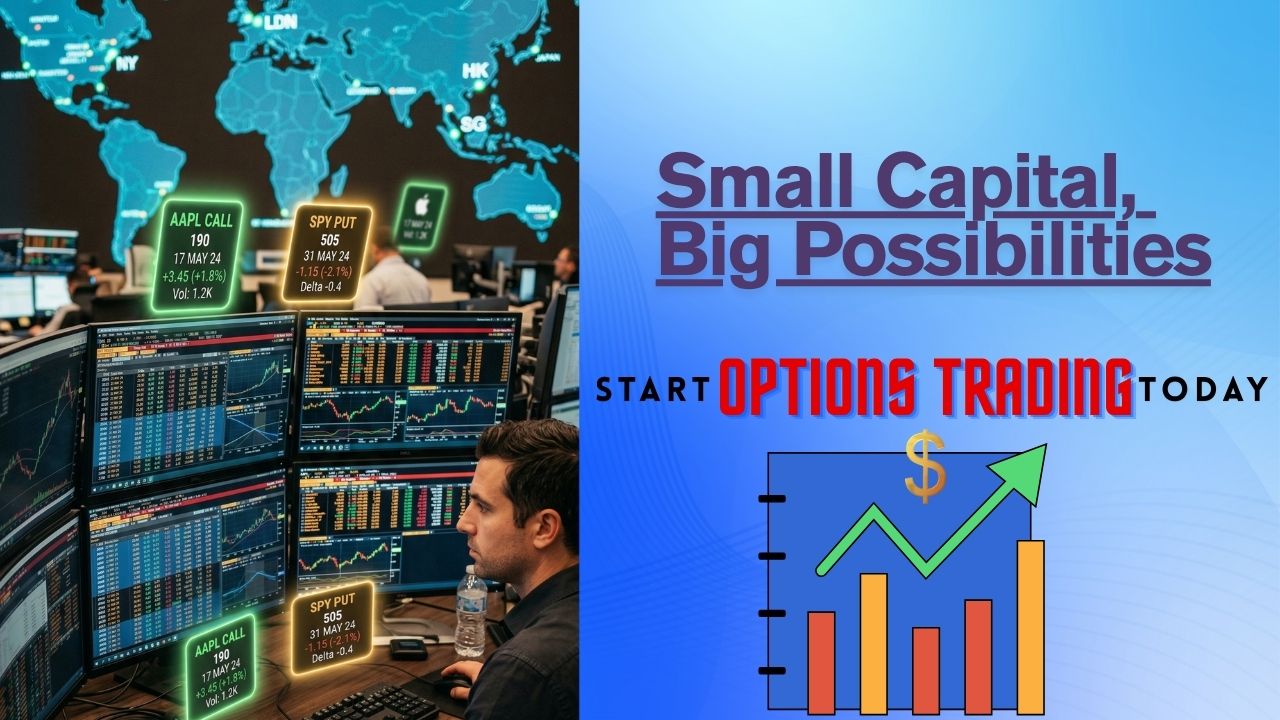
How to Start Options Trading with Small Capital
One of the biggest myths is that you need a lot of money to get started. That is not true. Here’s a step-by-step guide:
Step 1: Learn the Basics
Understand all the options trading terminologies like strike price, premium, expiry etc.
Step 2: Choose a Global Trading Platform
Popular platforms include:
- Interactive Brokers
- TD Ameritrade
- Binance (for crypto options)
Step 3: Start with Paper Trading (simulated trading)
Step 4: Begin with Small Trades
Trade options on affordable, lower-priced stocks or ETFs to keep premiums manageable
Step 5: Avoid risks
Stick to buying calls or puts first, as your maximum loss is limited to the premium paid. Avoid selling naked options until you are experienced, as the risk is theoretically unlimited. Start with monthly options rather than weekly ones to allow more time for your trade thesis to play out
This are the safest way to enter options trading for beginners’ step by step guide.
In India, for example, you can start options trading on NSE with as little as INR 5,000 to INR 10,000 by choosing index options wisely. In the US, some brokers allow fractional options or low-premium trades with capital under $500.
Options Trading vs Stock Trading: Which is Better
This is a question a lot of beginners ask, and we can say that it depends upon your goals and risk tolerance.
| Factor | Stock Trading | Options Trading |
|---|---|---|
| Capital Required | Moderate to High | Can start low |
| Risk Level | Moderate | Moderate to High |
| Profit Potential | Limited to price movement | High leverage possible |
| Complexity | Lower | Higher (more to learn) |
| Best For | Long-term growth | Short-term strategies |
| Expiry Pressure | None | Yes (time decay) |
So we can say in Stock Trading, you require higher capital where you buy actual shares and your profit depends on the price movement.
And in Options Trading, lower investment is required where you trade contracts and not stocks and you can profit in both rising and falling markets.
Neither is inherently better. Many serious investors do both. Stocks build your portfolio over time, while options trading can offer tactical income and hedging opportunities.
Want to know how to Trade Crypto on Binance Safely in 2026 then click
How AI is Changing Options Trading in 2026
Artificial intelligence has genuinely transformed how retail traders approach options trading. Tools that were once available only to institutional traders are now accessible to everyday investors. Below are some ways how AI has helped traders:
- AI-powered screeners can scan thousands of options contracts in seconds and flag unusual activity or potential breakout setups
- Sentiment analysis tools process news, social media, and earnings reports to give traders an edge before major price moves
- Algorithmic trading bots now execute options strategies automatically based on pre-set rules, helping remove emotion from decision-making
- Platforms like Tastytrade, Interactive Brokers, and Sensibull (India) have incorporated AI-driven analytics to make options analysis more intuitive
However, AI is only a tool. It enhances your decision-making of course but does not replace the need to understand what you are doing. The basics of options trading still matter enormously.
Authoritative Sources and Regulatory Bodies to Trust
| Authentic Sources | Requirement | Links |
|---|---|---|
| U.S. Securities and Exchange Commission (SEC) | Investor education and regulatory guidelines | www.sec.gov |
| U.S. Commodity Futures Trading Commission (CFTC) | Oversight of derivatives markets | www.cftc.gov |
| Options Clearing Corporation (OCC) | The world’s largest equity derivatives clearing organization | www.theocc.com |
| SEBI (Securities and Exchange Board of India) | India’s regulatory authority for securities and options | www.sebi.gov.in |
| NSE India | Official exchange data and investor education | www.nseindia.com |
| ESMA (European Securities and Markets Authority): | EU financial regulation | www.esma.europa.eu |
| Investopedia Options Guide | One of the most comprehensive beginner resources online | www.investopedia.com |
| CBOE (Chicago Board Options Exchange) | World’s leading options exchange, with free education tools | www.cboe.com |
Conclusion
Options trading is not a get-rich-quick scheme. It is a skill that takes time, practice, and patience to develop. But for those who put in the effort, it offers a genuinely flexible way to participate in financial markets with defined risk.
Start small. Learn the terminology. Practice with a demo account. Understand one strategy deeply before moving on to the next. And always, always manage your risk.
In 2026, with the right tools, the right knowledge, and a disciplined mindset, options trading can be a powerful addition to your financial journey. The global markets are accessible, the education resources are better than ever, and there has never been a better time to start learning
Stay consistent, and keep learning.
FAQs (Frequently Asked Questions)
Q1. What is options trading in simple terms?
Options trading is the buying and selling of contracts that give you the right, but not the obligation, to buy or sell an asset at a fixed price before a specific date. You pay a premium for this right and your maximum loss as a buyer is limited to that premium.
Q2. Is options trading risky for beginners?
Options trading does carry risk, especially if you do not understand the mechanics. However, buying call or put options limits your loss to the premium paid. The real danger comes from advanced strategies like selling naked options, which should be avoided until you have significant experience.
Q3. How much money do I need to start options trading?
You can start with a relatively small amount. In the US, some options can be bought for under $50 to $100. In India, index options on NSE can be traded with INR 5,000 to INR 15,000 in capital. That said, starting with a virtual account first is always the smartest move..
Q4. What is the difference between a call option and a put option?
A call option gives you the right to buy an asset at a fixed price and profits when the asset’s price goes up. A put option gives you the right to sell at a fixed price and profits when the price goes down. Together, they let you trade in both market directions.
Q5. Can options trading be done for passive income?
Yes. Strategies like covered calls and cash-secured puts are commonly used as a weekly options trading strategy for passive income. These involve selling options on stocks you already own or plan to buy, collecting the premium as income.
Q6. Is options trading legal and regulated globally?
Absolutely. Options trading is fully legal and regulated in all major markets. In the US, it is regulated by the SEC and CFTC and cleared through the OCC. In India, SEBI and NSE/BSE oversee the market. In Europe, ESMA sets the rules. Always trade through a licensed, regulated broker.
Q7. How is options trading different from stock trading?
When you trade stocks, you buy actual ownership in a company. With options trading, you purchase a contract based on a stock’s future price movement. Options offer more leverage and flexibility, but they also expire, which adds a layer of complexity that stocks do not have.
Q8. What are the best strategies for beginners in options trading?
The best starting strategies for beginners are long calls, long puts, covered calls, and protective puts. These are straightforward, have defined risk, and help you learn how options respond to price movement without exposing you to unlimited losses.
Q9. How does AI help in options trading in 2026?
AI tools now help traders scan options chains in real time, identify unusual volume activity, analyze market sentiment, and even automate simple strategies. Platforms like Sensibull and Tastytrade have integrated AI features that make options trading analysis faster and more accessible for everyday investors.
Q10. Which platform is best globally?
Interactive Brokers and TD Ameritrade are widely used. However, some trusted platforms are also used region wise.