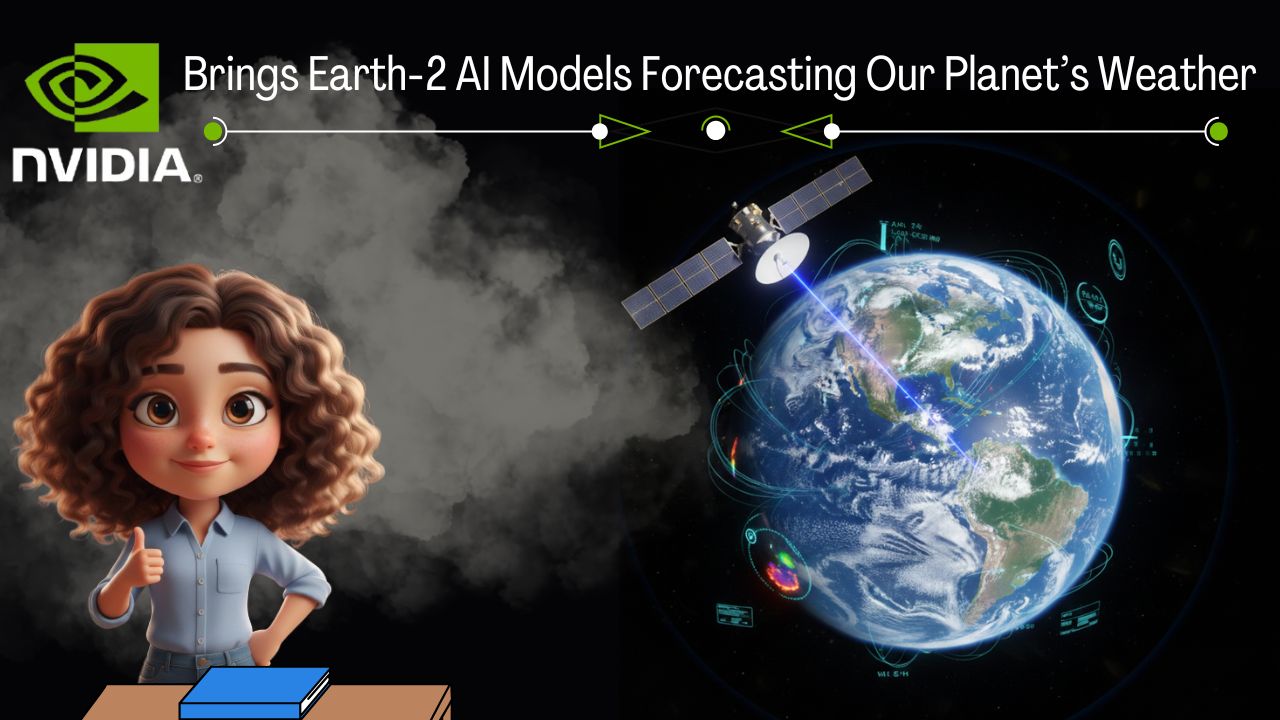
Weather affects every one of us from planning our day to protecting lives during storms and climate events. Yet forecasting has long been locked behind massive supercomputers and complex physics-based simulations. That changed on January 26, 2026, when NVIDIA launched the NVIDIA Earth 2 models, a fully open, AI-powered weather and climate forecasting platform that’s designed to be faster, more accurate, and accessible to scientists, governments, startups, and communities around the world.
In this blog, we’ll walk through what they are, why they matter, and how they are shaping the future of weather prediction.
What Are the NVIDIA Earth 2 Models?
The NVIDIA Earth 2 models are a family of open source AI weather models and tools that cover the complete forecasting pipeline from data processing to nowcasting, to medium-range predictions up to 15 days out. They represent what NVIDIA calls the world’s first fully open, accelerated AI weather stack.
Unlike traditional weather systems that need supercomputers crunching physics equations for hours, Earth-2 uses AI algorithms running on GPUs to cut forecast time to minutes or even seconds.
Official Confirmation and Dates
Launch Date: January 26, 2026.
Official Source & Announcement: NVIDIA corporate blog and product pages.
Event: American Meteorological Society Annual Meeting.
These provide clear authenticity that the Earth-2 models are real, open, and publicly supported by NVIDIA.
Why This Matters
Before Earth-2, weather prediction required huge computing power and specialized expertise. That meant only wealthy countries and large agencies could build and run high-quality weather models. The NVIDIA Earth 2 models are different:
- They are open source, meaning anyone can use, modify, and improve them.
- They’re AI-powered, which means faster, scalable forecasts.
- They’re designed for sovereign forecasting; nations can run their own systems without relying on third-party providers.
This is a huge leap toward democratizing weather forecasting technology for all.
Key components of the NVIDIA Earth 2 Models
Here’s a simple breakdown of the key models in the Earth-2 family:
1. Earth-2 Nowcasting
- Predicts short-term weather (0–6 hours) at kilometre-scale resolution.
- Uses generative AI to simulate real-time radar and satellite conditions.
- Helps emergency teams and local planners respond faster to severe storms.
2. Earth-2 Medium Range
- Designed for global weather forecasting up to 15 days ahead.
- Tracks more than 70 different weather variables, including temperature, humidity, and wind.
- Outperforms several existing open models on key accuracy benchmarks.
3. Earth-2 Global Data Assimilation (Coming Soon)
- Builds a snapshot of the current global atmosphere in seconds, replacing slow traditional methods.
- When paired with Medium Range, it boosts forecast accuracy and speed.
How NVIDIA Earth 2 Models Changes Weather Forecasting
Traditionally, weather forecasts are made by combining vast amounts of sensor data with physics-based equations. This has always needed supercomputers and lots of time. The NVIDIA Earth 2 models use AI to do much of this work smarter and faster.
This shift means:
- Faster predictions: models can run up to 1,000× faster than old methods.
- Lower costs: anyone with GPU access can deploy these tools.
- High resolution: detailed local forecasts help urban planning, agriculture, and emergency response.
- More innovation: open models let researchers and developers experiment and improve.
Read more for the latest details on NVIDIA – Groq Deal
Who’s Already Using Earth-2?
Even before full adoption, several organisations are piloting Earth-2 tools:
- Some meteorological services use Earth-2 to generate high-resolution, frequent forecasts.
- Energy companies use short-term predictions to plan grid operations.
- Data analytics and insurance firms use the forecasts to assess climate risk.
These early adopters show how flexible the Earth-2 platform is across industries.
Open Source and Getting Started
All Earth-2 tools and models are available through GitHub and platforms like Hugging Face, allowing developers to explore, modify, and build on top of NVIDIA’s work.
There are also developer toolkits like Earth2Studio that make it easier to construct and deploy forecasting systems for research or real-world applications.
GPU and AI – The Future of Weather Prediction
Using GPU-accelerated computing with AI opens capabilities once thought impossible for smaller teams:
- Running massive ensembles of predictions for improved uncertainty estimates.
- Customizing models for regional weather patterns.
- Combining global data with local sensors for city-level forecasting.
This is a major step toward truly global forecasts that everyone can access.
In Simple Terms
Think of NVIDIA Earth 2 models as a weather prediction engine that anyone can drive. Instead of needing deep technical expertise and expensive machines, researchers and planners can use open tools and AI to make powerful forecasts on common hardware even laptops with GPUs.
Read here for the official post i.e. NVIDIA Launches Earth-2 Family of Open Models
Conclusion
The NVIDIA Earth-2 models are changing the weather forecasting landscape forever. By combining open source access, AI-powered predictions, and GPU acceleration, Earth-2 makes advanced weather intelligence available for everyone, from climate researchers to governments and local planners.
Its launch on January 26, 2026 marks a milestone where weather forecasting becomes faster, cheaper, and more inclusive — not just a privilege for a few. That’s a future we can all weather together.
FAQs
1. What are NVIDIA Earth 2 models?
They are open-source AI weather forecasting models that deliver fast, accurate predictions from local nowcasts to 15-day global forecasts.
2. How are they different from traditional forecasts?
Unlike physics-based simulations on supercomputers, Earth-2 uses AI to significantly cut time, cost, and complexity.
3. Who can use them?
Scientists, developers, governments, and private organisations can use them because they’re open and free to access.
4. What does ‘Open Source Weather Models’ mean?
It means the software and models are publicly available for anyone to inspect, customize, and deploy.
5. Are these forecasts accurate?
Early benchmarks suggest they match or outperform many existing open models.
6. Do they replace human meteorologists?
No, but they give meteorologists better tools to make faster and more informed decisions.
7. What hardware do I need?
A modern GPU (Graphics Processing Unit) is recommended to run Earth-2 forecasts