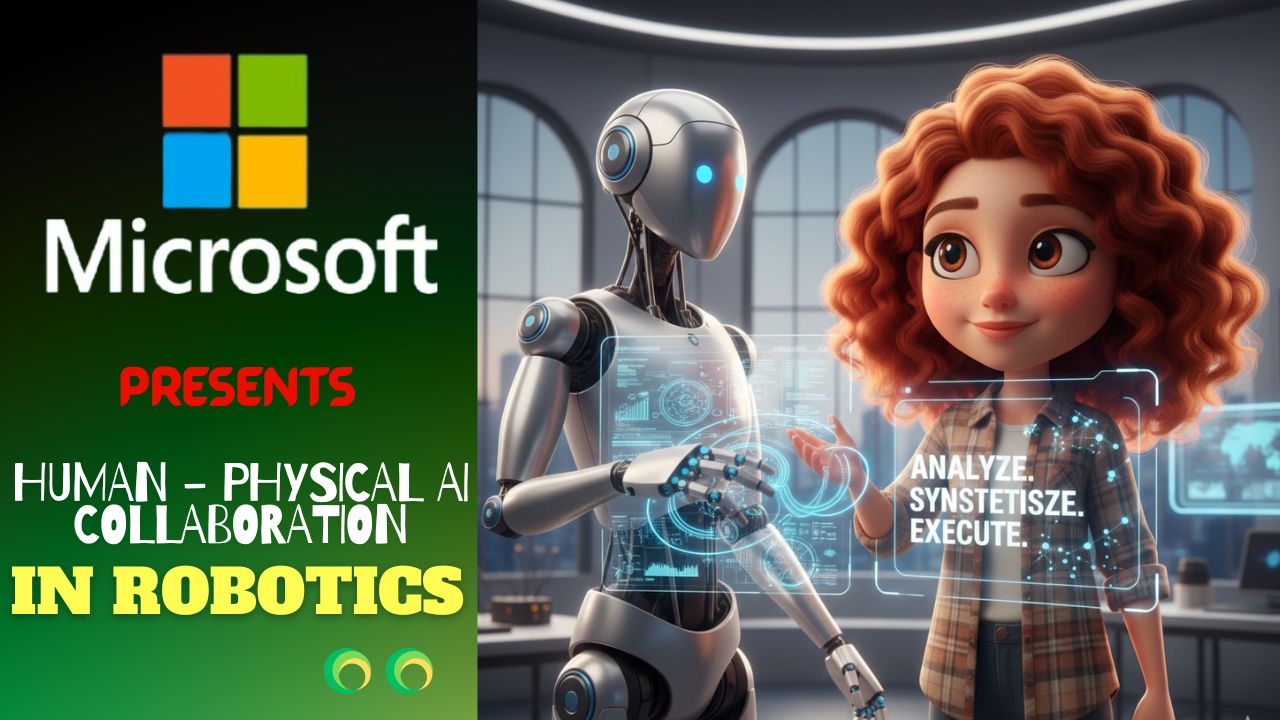
The world of artificial intelligence is rapidly moving beyond screens and text. With the launch of the Rho Alpha robotics model from Microsoft, AI has officially stepped into the physical world.
Announced on January 21, 2026, this new robotics foundation model is designed to help robots see, understand, feel, and act just like humans do.
Unlike traditional robots that rely on fixed programming, Rho-Alpha allows machines to understand natural language instructions and convert them into real physical actions. This marks a major milestone in the journey toward truly intelligent robots.
Microsoft developed Rho-Alpha through its research division as part of its broader mission to advance physical AI.
What Is Rho-Alpha?
The Rho Alpha robotics model from Microsoft is a robotics foundation model built to connect three critical abilities:
- Vision – understanding the environment visually
- Language – interpreting human instructions
- Action – performing precise physical movements
This combination is known as a Vision-Language-Action (VLA+) model, and Rho-Alpha takes it further by adding tactile sensing, allowing robots to feel pressure, contact, and movement.
In simple words, Rho-Alpha lets you talk to a robot, and the robot understands what to do and then actually does it.
Official Confirmation and Announcement Details
| Official Announcement Date | January 21, 2026 |
| Announced By | Microsoft Research |
| Status | Research & Early Access Phase |
| Availability | Research Early Access Program, with future rollout planned via Microsoft Foundry |
Microsoft officially confirmed that Rho-Alpha is currently being tested on dual-arm robots and humanoid platforms, making it suitable for complex real-world tasks.
Why Rho-Alpha Is a Big Deal in Robotics
Traditional robots work well only in controlled environments. The Rho Alpha robotics model from Microsoft changes this by allowing robots to adapt in real time.
Key breakthroughs include:
- Understanding everyday human language
- Coordinating two robotic arms together
- Using touch feedback to avoid errors
- Learning from human corrections
This makes Rho Alpha robotics model from Microsoft a strong step toward AI robots that understand language and act safely in unpredictable environments.
Core Capabilities of Rho-Alpha
1. Natural Language to Physical Action
You can give commands like: “Push the green button”, “Turn the knob slowly”, “Pull the red wire carefully” etc.
The robot understands intent and performs the task without needing manual coding.
2. Advanced Bimanual Manipulation
Rho-Alpha excels at bimanual robotic manipulation AI, allowing two arms to work together, something that has been extremely difficult in robotics until now.
3. Tactile and Sensory Awareness
Thanks to tactile input, robots can:
- Feel resistance
- Detect contact
- Adjust grip strength
This reduces breakage and improves safety.
How Rho-Alpha Is Trained
The Rho Alpha robotics model from Microsoft is trained using a mix of:
- Real-world robot demonstrations: Real robot runs where humans guide or supervise tasks.
- High-quality simulations: Synthetic data from physics simulators scales training beyond what’s feasible with hardware alone.
- Large-scale vision and language data: Web-scale image and language datasets provide semantic grounding so the model understands words like “knob,” “gripper,” or “tighten.”
This hybrid approach allows the model to generalize well across new tasks and environments, making it a true next generation robotics AI model.
Microsoft also says it’s working on pipeline and corpus optimizations for performance and efficiency.
Human-in-the-Loop Learning
Microsoft emphasizes that Rho-Alpha is not meant to replace humans but to work alongside them.
If a robot makes a mistake:
- A human can step in
- Correct the action
- The model learns from the correction
This makes the system safer and smarter over time.
Real-World Use Cases
The Rho Alpha robotics model from Microsoft has wide real-world potential:
Industrial & Manufacturing
- Flexible assembly lines
- Tool handling and adjustments
Healthcare & Labs
- Handling delicate instruments
- Repetitive lab automation
Warehousing & Logistics
- Sorting varied objects
- Operating in dynamic environments
Research & Education
- Robotics research
- AI-human collaboration studies
Rho-Alpha’s ability to accept a human instruction in natural language and attempt a coordinated manipulation lowers the bar for programming robots instead of writing motion sequences, teams can describe goals and correct the robot as needed.
ChatGPT Ads Are Coming: OpenAI’s Plan to Expand Access Without Losing Trust
How Rho-Alpha Fits into Microsoft’s AI Strategy
Rho-Alpha is part of Microsoft’s larger vision of physical AI robotics by Microsoft, connecting AI models with real-world action.
It complements:
- Cloud infrastructure
- Edge AI systems
- Enterprise robotics platforms
This integration positions Microsoft strongly in the future robotics ecosystem.
Official sources
- Primary (official): Microsoft Research: “Advancing AI for the physical world” / Rho-Alpha announcement (published January 21, 2026). Click here
- Microsoft company news: posts on Microsoft News/Source (January 21, 2026). Click here
Limitations to Keep in Mind
While powerful, the Rho Alpha robotics model from Microsoft is still in research mode:
- It’s not a plug-and-play replacement for established industrial controllers.
- Safety, robustness, and verification must be validated case-by-case before deployment in human-shared spaces.
- Tactile and force sensing helps, but perception failures, ambiguous language, or unexpected environment states can still cause mistakes.
Microsoft clearly promotes responsible AI deployment with human oversight.
Conclusion
The Rho Alpha robotics model from Microsoft represents a major shift in how robots interact with the real world. By combining vision, language, action, and touch, Microsoft is pushing robotics closer to human-like understanding and adaptability.
While still in early access, Rho-Alpha sets the foundation for a future where robots can follow spoken instructions, learn from humans, and safely operate in complex environments.
We can say Microsoft has made a meaningful step in making robots understand spoken or written instructions and feel what they do while coordinating two arms. It’s a research milestone more than a commercial product today, but because it’s being built on Microsoft’s Phi models and integrated into partner channels (Foundry, Early Access), it could accelerate practical, language-driven robotic systems in industrial and service contexts, provided teams proceed carefully with safety and verification.
This is not science fiction; it’s the next chapter of physical AI.
FAQs
Q1. What is the Rho Alpha robotics model from Microsoft?
It is a robotics foundation AI model that converts natural language instructions into real-world robotic actions.
Q2. When was Rho-Alpha officially announced?
Microsoft announced Rho-Alpha on January 21.
Q3. Is Rho-Alpha available to the public?
Currently, it is available through a Research Early Access Program.
Q4. What makes Rho-Alpha different from traditional robots?
It understands language, uses vision, and relies on tactile sensing to adapt in real time.
Q5. Does Rho-Alpha use two robotic arms?
Yes, it is optimized for bimanual (two-arm) manipulation.