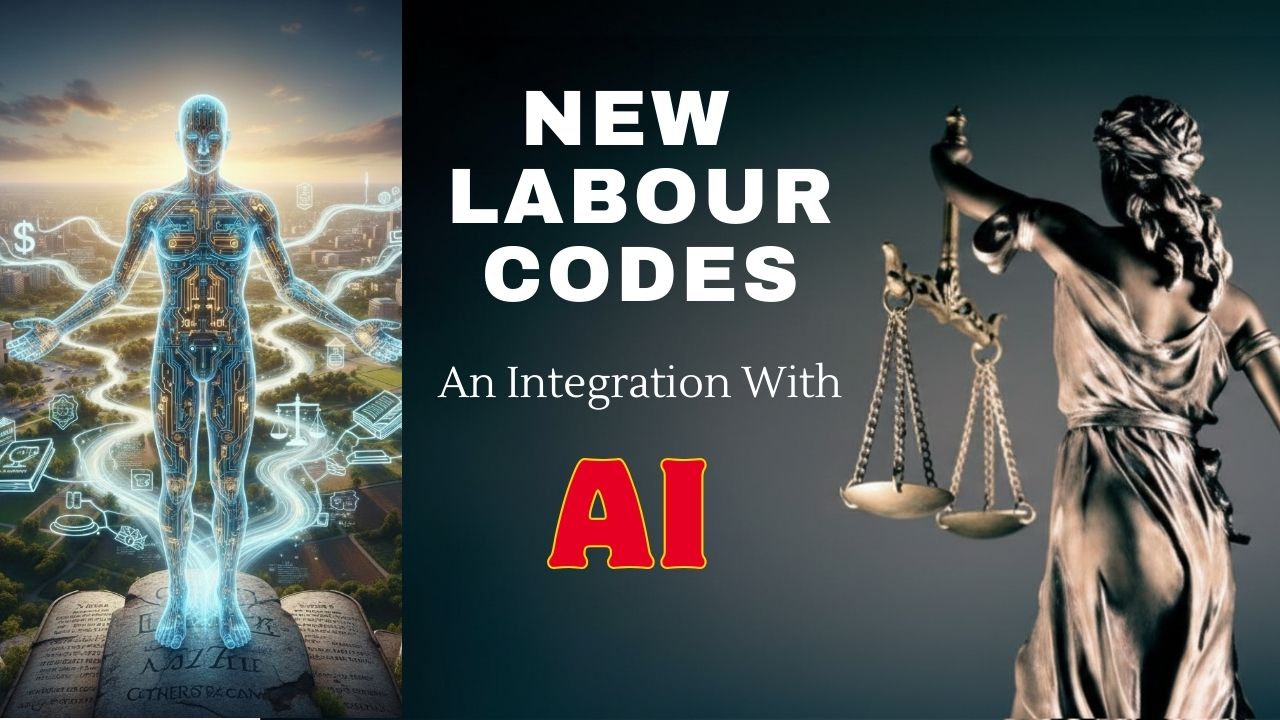
The implementation of the New Labour Codes 2025 marks a major shift in India’s current labour system, and AI will play a key role in ensuring smooth execution in the coming years.
India implemented the four consolidated Labour Codes — Code on Wages (2019), Industrial Relations Code (2020), Code on Social Security (2020) and Occupational Safety, Health and Working Conditions (OSHWC) Code (2020) — with effect from 21 November 2025, replacing 29 older labour laws. These New Labour Codes 2025 aims to simplify compliance, expand social security and strengthen workers / employee protections all over India.
But implementing these Codes across millions of workplaces is a huge challenge.
This is where AI (Artificial Intelligence) becomes a powerful helper.
Not to replace humans — but to support them, simplify compliance, reduce errors, and make the workplace a safer place to work.
Now, let’s see how AI can make each New Labour Codes 2025 work better for everyone.
Code on Wages (2019)
Problems this Code targets
- Minimum wage enforcement
- Correct overtime/bonus calculations
- Wide wage disparities across regions
- Employer errors.
How AI Helps
- Automated payroll systems: AI-driven payroll systems automatically calculate wages, overtime, bonus and deductions correctly.
- Anomaly detection tools can spot underpayments or incorrect salary entries before they turn into disputes.
- Dynamic compliance AI alerts The AI enabled payroll systems can track central/state notifications and map them to the payroll rules and can also alert the employers when minimum wages change in any state.
- Wage-gap analytics: Aggregated, de-identified AI analytics can spot sectoral or regional wage gaps (gender or skill-based), helping regulators set targeted minimum wage floors or corrective policies.
Simple Benefits:
With the help of AI, the workers can get their correct salary on time and the employers can avoid penalties and can reduce the cost of bearing HR consultants for these processes.
Industrial Relations Code (2020)
Problems this Code targets:
- Long grievance resolution time
- Repetitive/low-value tasks for labour officers
- Poor early-warning signals of workplace breakdowns.
How AI Helps:
- Chatbot-led grievance intake canaccept workers’ complaints 24/7 in simple language
- AI triage can send serious complaints to labour officers immediately.
- Predictive analytics warn employers about rising tensions or workplace issues so they can act early.
- AI-assisted case-management for tribunals: Natural language processing (NLP) can summarize past rulings, extract instances and speed up documentation which will help labour courts and conciliation officers to manage the caseloads more efficiently.
Simple Benefits:
Support from AI would lead to faster, more transparent dispute handling; fewer escalations; better use of government inspection/mediation resources.
Code on Social Security (2020)
Problems this Code targets:
- Low enrolment of informal/gig workers.
- Fragmented data across schemes
- Fraud and duplicate claims.
How AI Helps:
- Smart matching tools avoid duplicate entries and link workers’ records automatically.
- Eligibility & fraud detection models can detect fraud in claims and ensure genuine workers get benefits faster.
- Personalized SMS or IVR guidance can help gig workers, migrants, and informal workers to enrol in social-security schemes such as pension, health or maternity benefits, which would raise the coverage efficiently.
Simple Benefits:
More gig and migrant workers will be enrolled and they will get pensions, insurance, maternity benefits and other protections without hassle. This would subsequently help in better monitoring of expenditures.
Occupational Safety, Health and Working Conditions (OSHWC) Code (2020)
Problems this Code targets:
- Under-reporting of hazards
- Infrequent inspections
- Reactive rather than preventive safety measures.
How AI Helps:
- AI + sensors monitor machines and can alert managers before equipment fails (overheating, gas leaks, unsafe load)
- Real-time alerts can help to detect gas leaks, overheating or unsafe conditions so that the managers can act before any accidents occur.
- AI tools can help labour departments to choose which factories need urgent inspection.
- VR-based safety training with AI coaching gives workers, hands-on practice in a risk-free environment.
Simple Benefits:
Use of AI can help employers to ensure fewer workplace injuries, lower insurance and compensation costs and maintain a stronger safety culture.
Broader Applications of AI in New Labour Codes 2025
- AI dashboards can help government officers track nationwide compliance.
- Use of automatic filing tools can save time for HR teams and proper implementation of New Labour Codes 2025 .
- Multilingual chatbots can help workers in every state and makes services accessible to informal and rural workers both.
- AI can automate statutory returns for employers and spot mismatches before filings are submitted.
- AI also reduces paperwork and makes processes transparent.
Non Negotiable Risks & Safeguards New Labour Codes 2025
To use AI responsibly for all New Labour Codes 2025 we should make sure of these things:
Privacy & data protection:
- AI should collect only the necessary information.
- Workers’ personal data must be protected under Indian laws.
- Extra care would be needed for informal and vulnerable workers.
Bias & discrimination:
- AI must be checked regularly to remove hidden bias.
- It should not repeat old unfair patterns in hiring or pay.
- Every worker should get equal and fair treatment.
Transparency & explainability:
- If AI affects a decision, workers should know why it happened.
- Simple explanations must always be available on request.
- No secret or confusing AI decisions should come into effect for which sometimes manual scrutiny may be needed.
Legal clarity:
- AI tools must work within legal limits.
- Human officers should make final decisions—not AI alone.
- Workers’ rights like appeal and fair timelines must never be ignored.
Sources (Official government links) for the Acts and official government announcement for New Labour Codes 2025:
| New Labour Codes 2025 Acts ( Ministry of Labour & Employment — Labour Codes landing page (Govt. of India)) | Click here |
| “Four New Labour Codes 2025 — Implementation” (21 Nov 2025). | Click Here |
Also Read : Click Here
Final Thought(New Labour Codes 2025 & AI)
The four Labour Codes 2025 opens up chances for — a simpler legal framework and a big promise of wider protections for India’s workforce.
We need to understand that AI can accelerate that promise by different means— by automating repetitive compliance work, improving targeting of inspections and benefits, and giving workers easier access to grievance redressal.
But the benefits will arrive only if AI is deployed transparently, audited for fairness, and most importantly we have to always keep human decision-makers at the centre.